

This post contains affiliate links. As an Amazon Associate, 360 Car Seat earns from qualifying purchases, at no extra cost to you.
Rotating car seats offer remarkable convenience. However, many parents worry about whether their vehicle has enough room to accommodate one properly. This rotating car seat rear seat space guide explains exactly how much space these seats require, which vehicles work best, and how to avoid costly fitment mistakes. Furthermore, understanding a few key measurements can make the buying process significantly easier.
What Is a Rotating Car Seat?
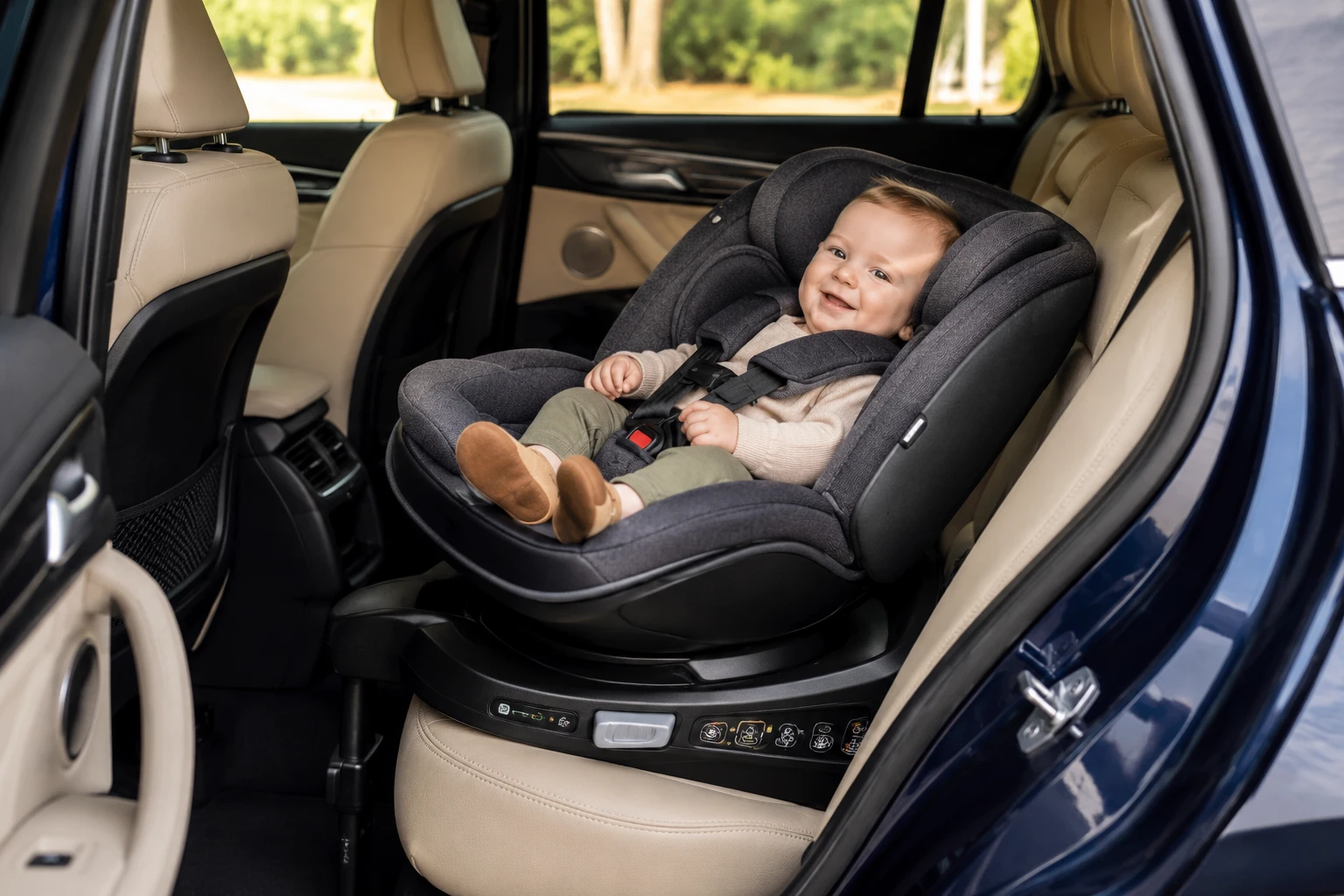
Although traditional convertible seats remain popular, rotating car seats have transformed daily routines for many families. Unlike fixed-position models, these seats swivel toward the vehicle door, making loading and unloading much simpler.
Understanding the Rotating Mechanism
Rather than remaining stationary, a rotating seat turns on a specialized base. Depending on the model, the seat may rotate 180 degrees or a full 360 degrees. Consequently, parents gain easier access to their child without excessive bending or twisting. Moreover, the engineering behind modern rotating car seats involves precise movement and structural stability. In some respects, manufacturers must carefully balance rotational efficiency with what engineers call kinematics, the study of motion and mechanical movement. As a result, the swivel mechanism must operate smoothly while maintaining strict safety standards.
Why Parents Prefer Rotating Car Seats
Although convenience often drives purchasing decisions, these seats offer several additional benefits. Advantages include:
- Easier child placement
- Faster buckling procedures
- Reduced strain on the back
- Better accessibility in tight parking spaces
- More comfortable daily use
As a result, many families quickly view the rotating feature as essential rather than optional.
Why Rear Seat Space Matters
While convenience is important, available space ultimately determines whether a rotating car seat will fit properly.
The Extra Clearance Needed for Rotation
Traditional seats remain fixed after installation. By contrast, rotating seats move through a turning arc. Therefore, surrounding clearance becomes extremely important. The seat must rotate without contacting:
- Vehicle doors
- Center consoles
- Adjacent child seats
- Interior trim panels
Otherwise, the rotation feature may become restricted or unusable.
Front-to-Back Space Requirements
In addition to side clearance, front-to-back room plays a major role. Rear-facing installations typically require the greatest amount of space because they use more recline. Consequently, front passenger legroom occasionally becomes limited in smaller vehicles. Nevertheless, this does not automatically eliminate compatibility. Instead, it highlights the importance of selecting a seat designed for your vehicle’s dimensions.
Vehicle Width Considerations
Likewise, vehicle width can significantly affect usability. Narrow rear benches may reduce flexibility when:
- Installing multiple child seats
- Seating additional passengers
- Using center-seat positions
- Performing full seat rotation
Furthermore, wider cabins often provide a more comfortable ownership experience over time. Vehicle interior design often involves a surprising level of complexity. Manufacturers analyze passenger positioning, storage requirements, and overall cabin ergonomics to maximize comfort without sacrificing functionality. Consequently, even small differences in rear-seat dimensions can significantly affect rotating car seat compatibility.
Understanding Rotating Car Seat Dimensions
Before purchasing any model, understanding basic dimensions can prevent disappointment later.
Height
Although height rarely creates fitment issues, it still influences everyday usability. A taller seat may:
- Improve child visibility
- Simplify loading
- Affect rear-window sightlines
Therefore, checking overall height remains worthwhile.
Width
Meanwhile, width becomes increasingly important for growing families. The following table illustrates common ranges:
| Seat Type | Typical Width |
|---|---|
| Traditional Convertible Seat | 17-20 inches |
| Standard Rotating Seat | 18-22 inches |
| Slim Rotating Seat | 16.5-18 inches |
Even seemingly minor differences can influence passenger comfort. As a result, every inch matters when maximizing rear-seat space.
Depth
More importantly, depth frequently determines overall compatibility. Depth measures how far the seat extends from front to back. Because rear-facing seats recline substantially, deeper models often consume additional cabin space. Therefore, compact-car owners should prioritize depth measurements during their research.
Base Size
Furthermore, the rotating base itself occupies space. Unlike standard car seats, swivel models require a specialized platform to support rotation. Consequently, manufacturers must balance compact dimensions with structural strength.
Rear-Facing Space Requirements
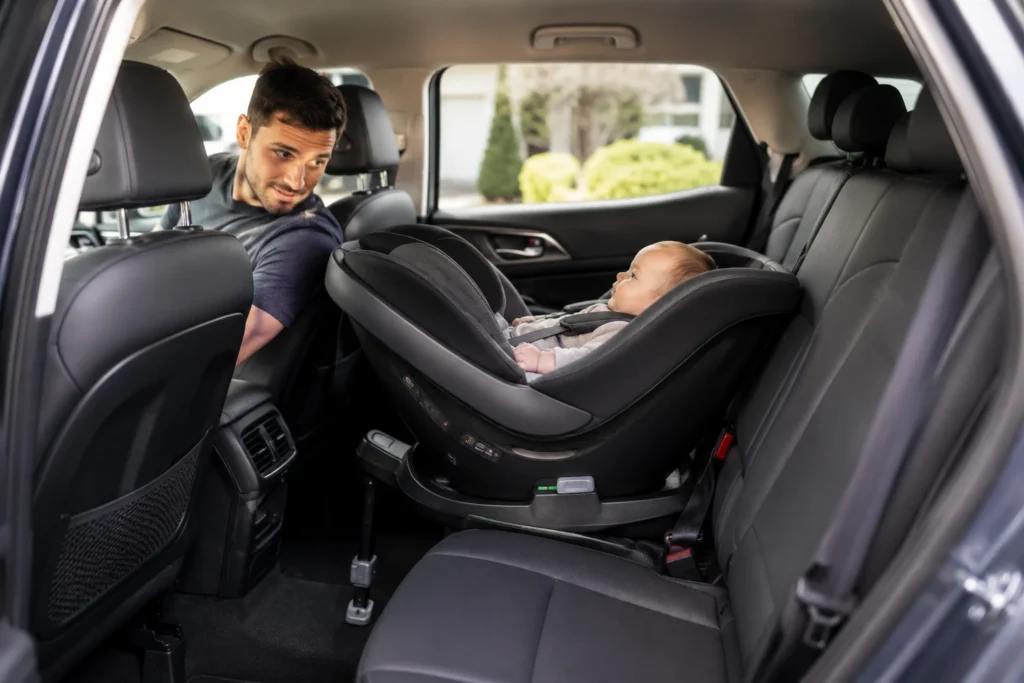
Among all installation stages, rear-facing configurations demand the most room. For that reason, every comprehensive rotating car seat rear seat space guide should address this topic thoroughly.
Why Rear-Facing Uses More Space
Rear-facing positioning prioritizes child safety. However, achieving proper installation requires:
- Greater recline angles
- Additional front-to-back clearance
- Increased separation from front seats
Accordingly, rear-facing mode typically creates the largest fitment challenges.
Typical Space Requirements by Vehicle Class
Although individual vehicles vary, the following table provides general expectations.
| Vehicle Category | Rear-Facing Fit Difficulty |
|---|---|
| Compact Car | Moderate to High |
| Midsize Sedan | Moderate |
| Compact SUV | Low to Moderate |
| Midsize SUV | Low |
| Minivan | Very Low |
Therefore, larger vehicles generally provide more flexibility. Nevertheless, many compact vehicles can still accommodate rotating seats successfully when paired with the right model.
Common Rear-Facing Challenges
Tall drivers frequently encounter unique concerns. For example, a driver over six feet tall may position the front seat farther rearward than average. Consequently, a large rotating seat installed directly behind the driver could reduce comfort. Fortunately, strategic placement often solves the problem. Many families choose the passenger-side rear position because it preserves driver space while maintaining accessibility.
Forward-Facing Space Requirements
Fortunately, space requirements become less demanding once children transition to forward-facing travel.
Why Space Needs Improve
Forward-facing installations use a more upright angle. As a result:
- Front passengers gain additional legroom
- Cabin flexibility improves
- Passenger comfort increases
- Installation becomes easier
Consequently, many parents notice a significant improvement in overall interior space.
Advantages for Growing Families
Furthermore, forward-facing configurations support changing family needs. Benefits often include:
- Easier seating arrangements
- Better accommodation for adults
- Improved access to neighboring seats
- Greater flexibility when adding another child seat
Accordingly, long-term ownership often becomes more convenient as children grow.
Vehicle Categories and Rotating Car Seat Compatibility
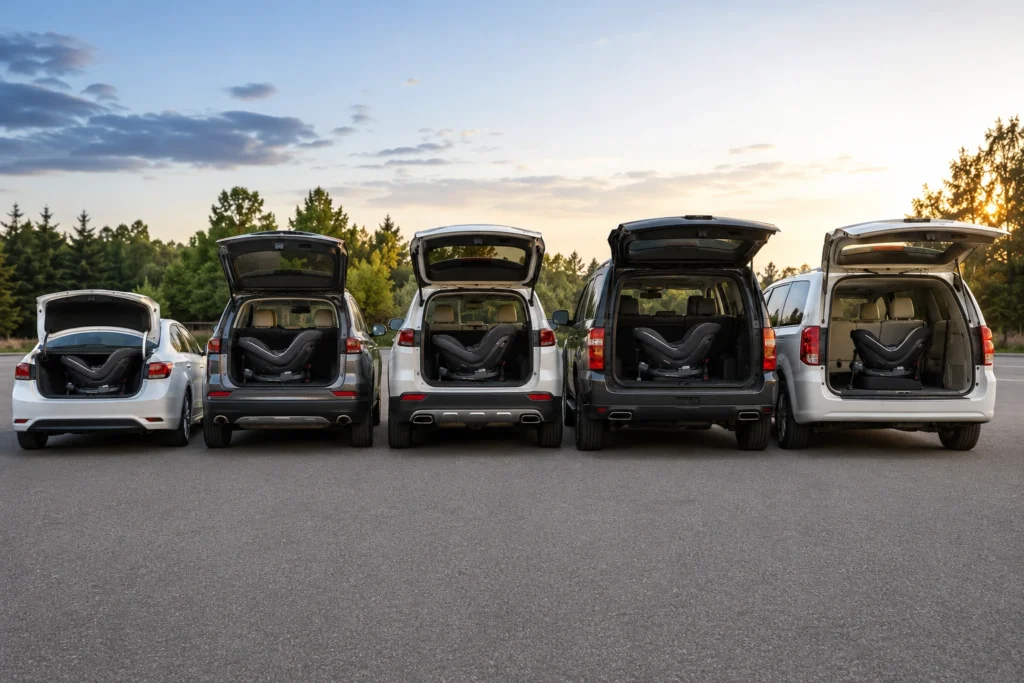
Not every vehicle offers the same experience with rotating car seats. Therefore, understanding your vehicle category can help establish realistic expectations.
Compact Cars
Common examples include:
- Honda Civic
- Toyota Corolla
- Hyundai Elantra
Although these vehicles offer limited interior dimensions, many rotating seats still fit successfully. However, choosing the correct model becomes especially important. In fact, families searching for the Best Rotating Car Seat for Compact Cars should focus closely on seat depth, overall width, and rear-facing clearance before making a final decision. Moreover, even a small dimensional difference can dramatically affect front passenger comfort. Consequently, reviewing manufacturer specifications before purchasing becomes essential.
Midsize Sedans
Popular examples include:
- Toyota Camry
- Honda Accord
- Hyundai Sonata
Compared with compact cars, midsize sedans typically provide noticeably greater flexibility. As a result, rear-facing rotating seats often fit with fewer compromises. Additionally, front passengers usually retain more usable legroom. Therefore, midsize sedans frequently represent an excellent balance between practicality and affordability for families considering a rotating car seat.
Compact SUVs
For many families, compact SUVs represent an ideal match for rotating car seats. Popular examples include:
- Honda CR-V
- Toyota RAV4
- Subaru Forester
- Mazda CX-5
Compared with sedans, these vehicles typically offer increased cabin height and additional rear-seat flexibility. Consequently, loading children becomes noticeably easier. Moreover, compact SUVs often provide larger door openings, which can improve access when rotating the seat toward the vehicle entrance. As a result, parents frequently experience fewer installation limitations than they would in smaller passenger cars.
Midsize SUVs
Meanwhile, midsize SUVs provide even greater accommodation. Examples include:
- Toyota Highlander
- Hyundai Palisade
- Kia Telluride
- Honda Pilot
Because these vehicles offer generous rear legroom, rotating seats generally fit without compromising front-seat comfort. Additionally, larger cabins simplify rear-facing installations. Therefore, parents can often position front seats according to personal comfort rather than car seat restrictions. Furthermore, wider second-row seating creates additional flexibility when transporting multiple children.
Full-Size SUVs and Minivans
If maximum space is the goal, full-size SUVs and minivans remain difficult to beat. Common choices include:
- Honda Odyssey
- Toyota Sienna
- Chrysler Pacifica
- Chevrolet Tahoe
Not only do these vehicles provide exceptional legroom, but they also deliver superior accessibility. Consequently, rotating seats can function exactly as intended without significant space concerns Likewise, sliding doors on minivans improve loading convenience in crowded parking lots. Accordingly, families with multiple children often consider these vehicles the most practical long-term solution.
How to Measure Your Vehicle Before Buying
Although manufacturer specifications provide useful information, taking measurements yourself can prevent unexpected surprises.
Measure Rear Legroom
First, determine how much space exists between the front and rear seats. Next, compare those measurements against the car seat dimensions provided by the manufacturer. This simple step can immediately eliminate incompatible options.
Evaluate Front Seat Position
Since every driver sits differently, seat position matters considerably. Therefore, adjust the front seats to their normal driving positions before taking measurements. Otherwise, the results may not accurately reflect real-world conditions.
Check Door Opening Width
Likewise, door opening dimensions affect usability. A rotating seat requires sufficient clearance to turn toward the doorway comfortably. Consequently, narrow openings may reduce overall convenience despite successful installation.
Review Seat Cushion Shape
In addition, rear seat cushions vary substantially between vehicles. Some cushions sit flat. Others feature pronounced contours. As a result, installation angles may differ significantly even between vehicles of similar size.
Study Manufacturer Specifications
Before purchasing, carefully examine:
- Seat width
- Overall depth
- Base dimensions
- Rear-facing requirements
- Recommended vehicle compatibility
Thereafter, compare those measurements directly against your available space.
Test Rotation Clearance
Whenever possible, test the seat in person. Although online measurements provide valuable guidance, physical testing offers the highest level of confidence. Therefore, many retailers encourage trial installations before purchase.
Common Rotating Car Seat Space Myths
Misconceptions frequently influence buying decisions. Fortunately, many assumptions are inaccurate.
Myth: Every SUV Has Plenty of Space
While SUVs generally offer larger cabins, interior dimensions vary considerably. Therefore, some compact SUVs provide less usable space than certain midsize sedans. Consequently, vehicle classification alone should never determine compatibility.
Myth: Rotating Seats Are Always Huge
Although some rotating models are relatively large, others prioritize compact design. In recent years, manufacturers have introduced slimmer options specifically for smaller vehicles. As a result, many families discover excellent fitment even in limited spaces.
Myth: Rear-Facing Always Eliminates Front Legroom
Certainly, rear-facing seats require additional room. However, installation position, seat design, and vehicle dimensions all influence the outcome. Therefore, many properly matched combinations preserve acceptable passenger comfort.
Myth: Multiple Rotating Seats Fit Everywhere
Unfortunately, this assumption often causes frustration. Even though one rotating seat may fit comfortably, two or three can create new challenges. Accordingly, families planning multi-seat configurations should verify measurements carefully before purchasing.
Best Rotating Car Seats for Smaller Vehicles
Fortunately, several models focus specifically on maximizing interior space.
Nuna REVV
The Nuna REVV remains popular among parents seeking premium quality. Key advantages include:
- Compact footprint
- Smooth rotation
- High-end materials
- Simplified installation
Consequently, it performs well in many compact and midsize vehicles.
Chicco Fit360 ClearTex
Meanwhile, the Chicco Fit360 has gained attention for its practical design. Benefits include:
- Efficient dimensions
- User-friendly operation
- Excellent accessibility
- Strong everyday usability
Furthermore, many parents appreciate its balance between comfort and space efficiency.
Evenflo Revolve360 Slim
As the name suggests, the Revolve360 Slim focuses on conserving valuable cabin space. Advantages include:
- Narrow profile
- Easier multi-seat configurations
- Improved passenger flexibility
- Compact installation footprint
Therefore, it remains one of the strongest choices for smaller vehicles.
Baby Jogger City Turn
Unlike traditional swivel systems, the City Turn uses a unique turning approach. As a result, parents often find loading children significantly easier. Additionally, its innovative design can reduce some space-related concerns found in larger rotating seats.
Tips for Maximizing Rear Seat Space
Even after selecting the right seat, several strategies can further improve comfort.
Install Behind the Passenger Seat
Whenever practical, consider placing the seat behind the front passenger. Consequently, drivers retain maximum seating flexibility.
Adjust Front Seats Strategically
Rather than reclining excessively, position front seats more upright. As a result, additional rear-seat clearance becomes available.
Follow Recline Guidelines Carefully
Although some parents assume deeper recline is always preferable, manufacturer recommendations should guide installation. Therefore, using the correct angle may preserve valuable space.
Consider Slim Rotating Models
If cabin dimensions are limited, prioritize compact designs. Accordingly, narrower models often improve long-term satisfaction.
Verify Fit Before Purchase
Above all, confirm compatibility whenever possible. Because every vehicle differs, real-world testing remains the most reliable approach.
Final Thoughts
Ultimately, choosing the right rotating car seat involves more than selecting features or safety ratings. Instead, understanding vehicle dimensions, installation requirements, and available clearance helps ensure a comfortable fit. By measuring carefully and comparing specifications thoughtfully, families can enjoy the convenience of a rotating seat without sacrificing valuable interior space.
FAQs
Generally, yes. The swivel mechanism and rotating base often require additional clearance, particularly during rear-facing use.
Yes, many rotating models fit compact vehicles. However, checking seat dimensions and vehicle measurements beforehand is essential.
Front-to-back space is usually the primary concern. Rear-facing installations often affect front passenger legroom more than seat width.
Yes, many rotating car seats are designed specifically for infants and meet the same safety standards as traditional car seats.
Midsize SUVs, full-size SUVs, and minivans generally provide the most flexibility due to their larger rear seating areas.
Yes, although taller drivers may experience reduced seat adjustment. Many families find the passenger-side rear position more practical.
No. Some models rotate a full 360 degrees, while others offer 180-degree rotation for easier child access.
It depends on the vehicle width and the seat dimensions. Slim rotating models typically offer the best chance for multi-seat installations.
Measure rear legroom, door opening width, and front seat position, then compare those measurements with the manufacturer’s specifications.
For many parents, absolutely. The convenience of easier loading, unloading, and buckling often outweighs the modest increase in space requirements.

