

This post contains affiliate links. As an Amazon Associate, 360 Car Seat earns from qualifying purchases, at no extra cost to you.
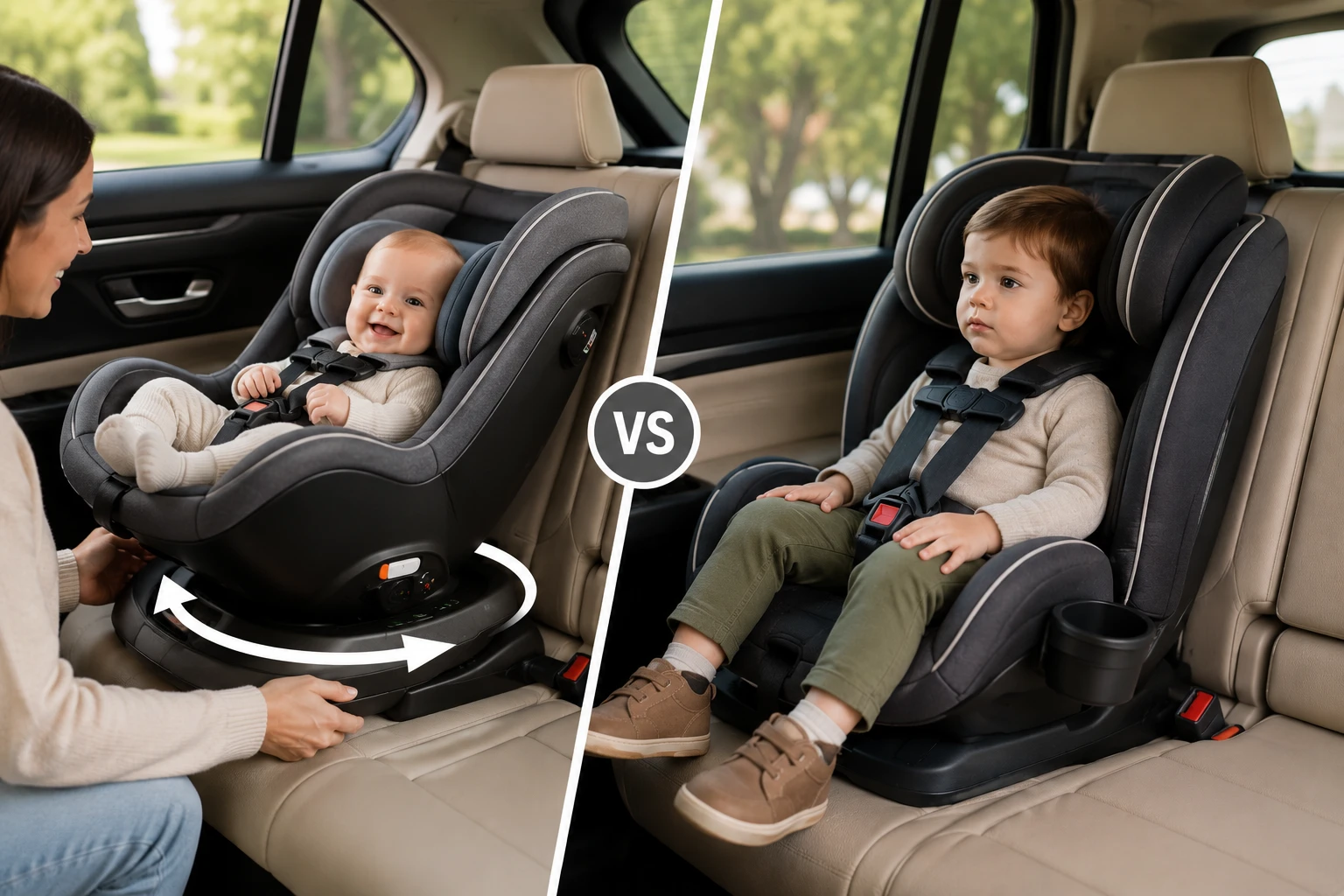
Choosing a car seat is no longer as simple as picking the first highly rated model you find online. Today, parents have more options than ever. As a result, the debate around rotating car seat vs traditional car seat has become increasingly common. Both options are designed to keep children safe. However, they offer very different experiences for parents and caregivers. While rotating car seats focus on convenience and accessibility, traditional car seats prioritize simplicity, affordability, and familiarity. So which one deserves a place in your vehicle? Let’s take a closer look.
Understanding the Basics
Before comparing features, it’s important to understand what separates these two categories.
What Is a Rotating Car Seat?
A rotating car seat features a swivel mechanism that allows the seat to turn toward the vehicle door. Consequently, parents can place their child into the seat while facing them directly rather than leaning awkwardly into the vehicle. Once the child is buckled, the seat rotates back into its travel position. Depending on the model, the seat may rotate 180 degrees or a full 360 degrees. Furthermore, many rotating car seats function as convertible seats, allowing children to remain in the same seat through multiple growth stages.
What Is a Traditional Car Seat?
By comparison, a traditional car seat remains fixed after installation. The seat does not rotate or swivel. Instead, parents must reach into the vehicle to secure their child. Traditional options include:
- Infant car seats
- Convertible car seats
- Combination seats
- Booster seats
Notably, these seats have been trusted by families for decades and continue to dominate the market today.
Rotating Car Seat vs Traditional Car Seat: Quick Comparison
At first glance, both options may seem similar. Nevertheless, several meaningful differences separate them.
| Feature | Rotating Car Seat | Traditional Car Seat |
|---|---|---|
| Ease of Loading Child | Excellent | Average |
| Parent Comfort | Excellent | Moderate |
| Safety Standards | High | High |
| Price | Higher | Lower |
| Weight | Heavier | Lighter |
| Vehicle Compatibility | Varies | Broad |
| Installation Complexity | Moderate | Moderate |
| Convenience | Excellent | Good |
| Availability | Limited Models | Wide Selection |
Overall, convenience and cost tend to be the biggest deciding factors.
Ease of Getting Your Child In and Out
For many parents, this category alone influences the final decision.
Why Rotating Seats Are So Popular
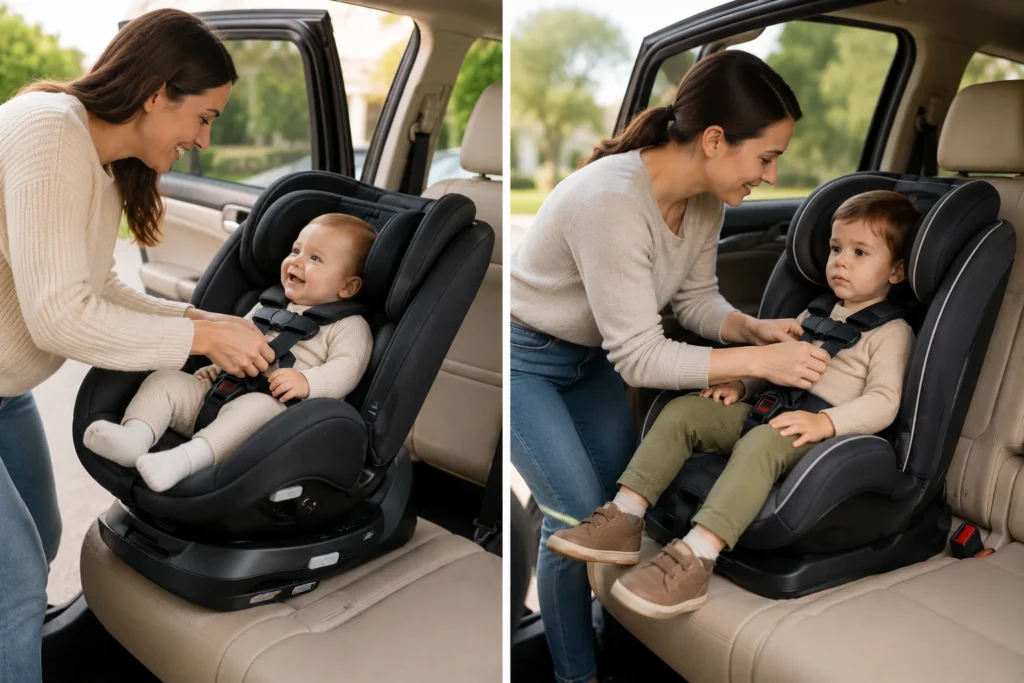
Let’s be honest. Loading an infant or toddler into a rear-facing car seat can be frustrating. You bend over. You twist. Then you try to tighten the harness while your child suddenly becomes surprisingly determined to escape. Fortunately, rotating seats simplify this process. Because the seat turns toward the door, parents can access harness straps and buckles more comfortably. In turn, daily loading becomes faster and less stressful. Additionally, children are easier to position correctly, particularly when wearing bulky winter clothing.
Traditional Seats Still Perform Well
On the other hand, traditional seats remain practical for millions of families. Most parents quickly develop efficient routines that make loading easier over time. Likewise, older toddlers often climb into their seats independently, reducing the need for extra convenience features. For that reason, some families may find that a rotating mechanism provides little additional value.
Parent Comfort Matters More Than You Think
Safety receives most of the attention. Even so, caregiver comfort deserves consideration as well.
Reduced Back and Shoulder Strain
Parents lift children countless times throughout the year. Eventually, repetitive lifting and twisting can become physically demanding. This is where rotating seats frequently stand out. Since the seat turns toward the door, caregivers spend less time reaching into the vehicle. As a result, the process places less strain on the back, shoulders, and neck. This benefit can be particularly valuable for:
- New parents
- Grandparents
- Caregivers with mobility limitations
- Families with larger vehicles
- Parents managing chronic back discomfort
Moreover, the convenience remains valuable long after the initial excitement of a new purchase fades.
Traditional Seats Require More Movement
Meanwhile, traditional seats generally require more bending and reaching. Although many parents adjust quickly, others find the repeated motion tiring over time. Still, individual preferences vary significantly. Some families never view this as an inconvenience at all.
Safety Comparison
Whenever parents discuss rotating car seat vs traditional car seat, safety naturally becomes the most important topic.
Are Rotating Car Seats Safe?
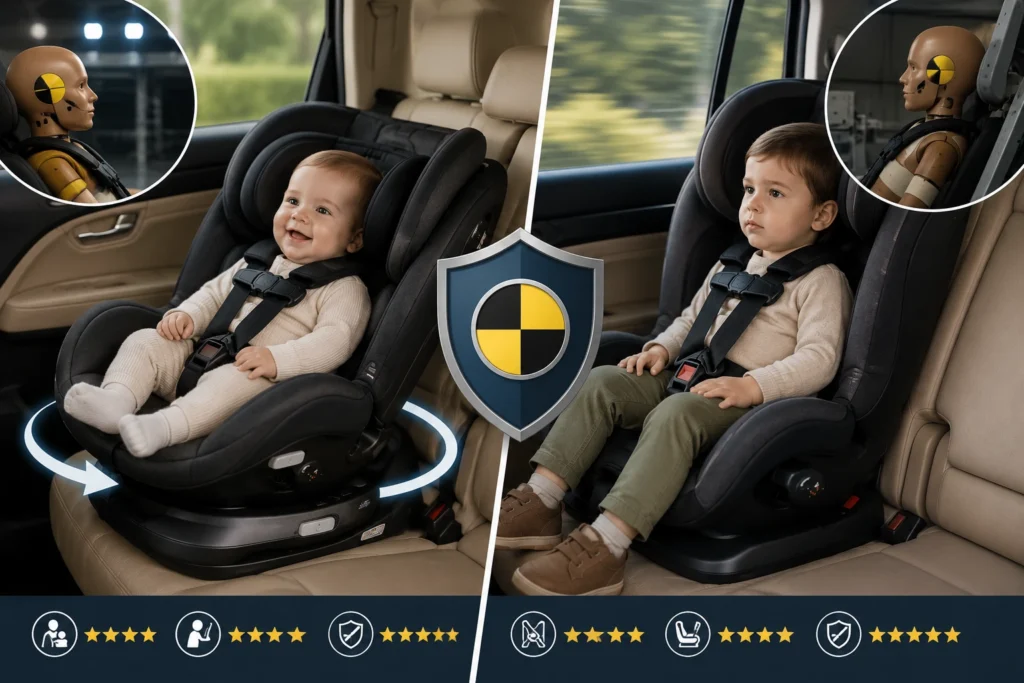
Absolutely. Rotating seats sold in the United States must meet federal safety requirements before reaching consumers. Therefore, rotating models undergo extensive crash testing just like traditional car seats. The swivel mechanism itself does not make a seat inherently less safe. Instead, proper usage remains the critical factor.
Common Safety Features Found in Both
Regardless of design, many modern car seats include advanced safety features. These often include:
- Five-point harness systems
- Side-impact protection
- Energy-absorbing materials
- Reinforced frames
- Adjustable headrests
As technology advances, manufacturers continue improving protection across both categories. Modern car seat engineering involves extensive testing and design refinement. In some ways, the process resembles principles studied in tribology, the science of friction, wear, and interacting surfaces, which helps engineers understand how mechanical components perform over time.
Safety Myths Parents Should Ignore
Unfortunately, misconceptions often influence purchasing decisions. For example, some parents assume that moving parts automatically reduce safety. However, certified rotating seats must satisfy the same regulatory requirements as fixed-position models. Consequently, parents should focus less on marketing claims and more on correct installation and daily usage.
Installation and Setup
Installation quality often matters more than the specific seat chosen.
Installing a Rotating Car Seat
Rotating seats typically include additional components because of the swivel mechanism. As a result, some parents experience a slightly steeper learning curve during initial setup. Parents researching How to Install an Evenflo Revolve 360 Car Seat often discover that carefully following manufacturer instructions makes the process significantly easier while helping ensure optimal performance. To simplify installation:
- Read the manual thoroughly
- Verify lock positions
- Test seat movement after installation
- Confirm harness routing
- Check recline indicators
Manufacturers spend years refining installation systems and user interfaces. This attention to detail reflects a concept known as ergonomics, a field focused on designing products that improve human interaction, comfort, and efficiency.
Installing a Traditional Car Seat
Conversely, traditional seats often feel more familiar to parents. Many caregivers have previous experience with fixed-position models. Therefore, setup may feel less intimidating. Nevertheless, installation mistakes remain common across all car seat categories. For that reason, reviewing instructions carefully remains essential regardless of seat type.
Vehicle Space Considerations
Not every seat fits every vehicle equally well.
How Much Room Does a Rotating Car Seat Need?
Before purchasing a rotating seat, vehicle dimensions should be evaluated carefully. Because the seat must rotate freely, adequate clearance is necessary. Important factors include:
- Rear-seat dimensions
- Door opening width
- Front-seat positioning
- Passenger space requirements
Consequently, compact vehicles may present more fitment challenges.
Traditional Seats in Tight Spaces
Traditional seats often provide greater flexibility in smaller vehicles. Likewise, families needing three car seats across a single row frequently discover more options among traditional designs. As a result, vehicle compatibility can become a major advantage for fixed-position models.
Cost Comparison
Price often becomes the deciding factor when parents compare a rotating car seat vs traditional car seat. After all, car seats represent a significant investment, especially for families with multiple children.
Why Rotating Car Seats Cost More
Rotating seats typically command higher prices because they contain additional engineering and moving components. Beyond the swivel mechanism itself, manufacturers invest heavily in research, testing, and product development. Consequently, these seats often fall into premium pricing categories. Additional factors that contribute to higher costs include:
- Advanced rotation systems
- Enhanced convenience features
- More complex manufacturing processes
- Additional testing requirements
- Premium materials
Although the upfront expense can feel substantial, many parents believe the convenience offsets the added cost over time.
Traditional Car Seat Pricing
In contrast, traditional seats cover a much broader price range. As a result, families can find quality options that align with nearly any budget.
| Budget Level | Traditional Seat Range |
|---|---|
| Budget | $100–$200 |
| Mid-Range | $200–$350 |
| Premium | $350–$600+ |
Meanwhile, rotating seats frequently start where traditional mid-range models end.
Is the Extra Cost Worth It?
Ultimately, value depends on daily usage. For example, parents loading an infant multiple times every day may quickly appreciate the benefits of a rotating seat. By comparison, occasional drivers may struggle to justify the additional investment. Therefore, evaluating your family’s specific routine remains one of the smartest ways to determine overall value.
Longevity and Growth With Your Child
A car seat should ideally support your child through multiple stages of development. Accordingly, longevity deserves careful consideration.
Rotating Car Seat Lifespan
Many rotating seats function as convertible models. This means they often accommodate:
- Rear-facing infants
- Rear-facing toddlers
- Forward-facing children
Consequently, a single purchase may provide years of use. Furthermore, some models support extended rear-facing periods, which many safety experts encourage.
Traditional Car Seat Lifespan
Likewise, traditional seats are available in numerous configurations. Certain models transition through several growth stages, including:
- Infant mode
- Convertible mode
- Forward-facing mode
- Booster mode
Therefore, long-term usability is not exclusive to rotating seats. Instead, comparing individual weight and height limits provides a clearer picture of expected lifespan.
Which Families Benefit Most From a Rotating Car Seat?
While rotating seats are not necessary for every household, certain families tend to benefit significantly.
Ideal Scenarios
Rotating seats may be particularly valuable for:
- First-time parents
- Grandparents providing childcare
- Families driving larger SUVs
- Parents recovering from injuries
- Caregivers with mobility challenges
- Households frequently transporting infants
Moreover, families who spend substantial time in vehicles often appreciate the added convenience. Over several years, those daily time savings can become surprisingly meaningful.
Which Families Benefit Most From a Traditional Car Seat?
Conversely, traditional seats remain an excellent solution for many parents.
Ideal Scenarios
Traditional models may be better suited for:
- Budget-conscious households
- Families needing multiple seats
- Owners of compact vehicles
- Parents of older toddlers
- Occasional caregivers
- Families prioritizing simplicity
Additionally, traditional seats offer a wider variety of designs and price points. Because of that flexibility, finding a suitable model is often easier.
Real-World Pros and Cons
Every car seat category comes with advantages and trade-offs. Understanding both sides creates a more balanced perspective.
Rotating Car Seat Pros
- Easier child loading
- Improved buckle access
- Reduced physical strain
- Better ergonomics for caregivers
- Enhanced convenience during daily use
Rotating Car Seat Cons
- Higher initial cost
- Heavier overall weight
- Potential vehicle compatibility limitations
- Fewer models available
Traditional Car Seat Pros
- Lower purchase price
- Greater selection
- Broad vehicle compatibility
- Simpler overall design
- Easier replacement options
Traditional Car Seat Cons
- Increased bending and reaching
- Less convenient for rear-facing infants
- Harder harness access in some situations
Consequently, the right choice depends largely on which advantages matter most to your family.
Common Mistakes Parents Make When Choosing
Parents sometimes focus exclusively on product features. However, convenience features alone rarely determine long-term satisfaction. Instead, consider practical questions such as:
- How often will the seat be used?
- Who will install it?
- Who will load the child most frequently?
- How large is the vehicle?
- What budget constraints exist?
- Are there physical limitations to consider?
Subsequently, the best option often becomes much clearer. Another common mistake involves assuming expensive automatically means better. In reality, the most effective car seat is the one that fits your child properly, installs correctly, and gets used consistently.
Rotating Car Seat vs Traditional Car Seat: Which One Should You Choose?
At this stage, the answer should feel more straightforward. If convenience, accessibility, and caregiver comfort rank among your top priorities, a rotating seat may deliver exceptional value. In particular, parents of infants often notice the benefits immediately. Alternatively, traditional seats continue to offer excellent performance at a lower price point. Their affordability, broad compatibility, and extensive selection make them attractive for many households. When evaluating rotating car seat vs traditional car seat, there is no universal winner. Rather, the best decision depends on your vehicle, budget, lifestyle, and daily routine.
Final Thoughts
The discussion surrounding rotating car seat vs traditional car seat ultimately comes down to convenience versus simplicity. While rotating seats can make daily loading easier and more comfortable, traditional seats remain dependable, affordable, and widely available. Regardless of which option you choose, proper installation and consistent use matter far more than the seat’s ability to rotate. Therefore, focus on finding a model that fits your child, your vehicle, and your lifestyle. When those factors align, you’ll be making a smart investment in both safety and everyday convenience.
FAQs
No. Rotating and traditional car seats must meet the same federal safety standards, and proper installation is more important than the seat type itself.
For many parents, especially those loading infants daily, the added convenience and reduced physical strain can make the higher cost worthwhile.
Some can, but vehicle compatibility varies by model. Always check the manufacturer’s fit guide before purchasing.
Many rotating seats are convertible models that can accommodate children for several years, similar to many traditional convertible car seats.
They may have a slightly steeper learning curve due to the swivel mechanism, but most parents find installation manageable when following the instructions carefully.
Parents often appreciate being able to turn the seat toward the door, making it easier to place, buckle, and remove their child.
Yes. Rotating seats can reduce bending, twisting, and reaching, which may be especially helpful for older caregivers.
Yes. Traditional seats are generally more affordable, lighter, and available in a wider variety of styles and sizes.
In most cases, yes. The rotating mechanism and additional components typically add extra weight to the seat.
Focus on your vehicle size, budget, daily routine, and comfort needs. The best seat is the one that fits your child correctly and is used properly every trip.

