

This post contains affiliate links. As an Amazon Associate, 360 Car Seat earns from qualifying purchases, at no extra cost to you.
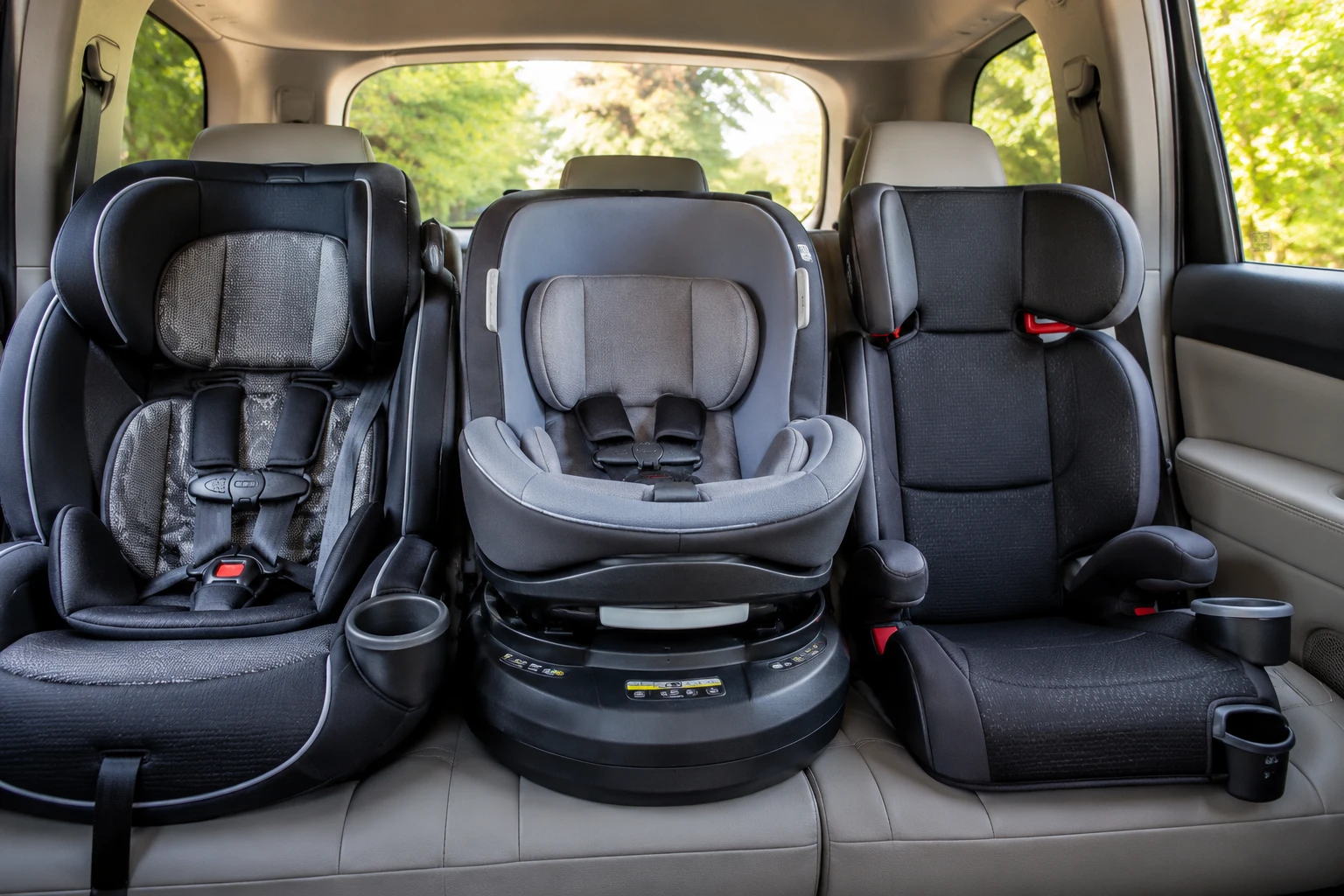
Fitting three child seats in one row can feel overwhelming. However, many families successfully use a rotating car seat for three across with the right planning. While swivel seats offer exceptional convenience, they also require careful consideration because space becomes limited quickly. Fortunately, a three-across setup is often achievable. Moreover, modern rotating seats have become more compact than earlier models. Therefore, parents no longer have to choose between accessibility and seating capacity. Nevertheless, not every rotating seat will fit every vehicle. Consequently, understanding measurements, seat width, and installation requirements is essential before making a purchase. In this guide, you’ll learn exactly how to determine whether a rotating car seat for three across is the right solution for your family.
What Is a Rotating Car Seat?
A rotating car seat pivots on its base, allowing parents to turn the seat toward the vehicle door during loading and unloading. Some models rotate 180 degrees, whereas others provide a full 360-degree swivel. As a result, securing a child often becomes much easier. The convenience factor is significant. Instead of twisting awkwardly into the vehicle, parents can face their child directly. Consequently, harnessing becomes simpler and less stressful. Furthermore, grandparents and caregivers often find rotating seats easier to use. Common benefits include:
- Easier loading and unloading
- Reduced back and shoulder strain
- Better harness visibility
- Improved accessibility
- Enhanced day-to-day convenience
Therefore, it is easy to see why rotating seats continue to gain popularity among growing families.
What Does Three Across Mean?
A three-across setup refers to installing three child restraints side by side within a single vehicle row. Typically, families need this arrangement when:
- They have three young children
- A new baby is arriving
- Multiple children ride together regularly
- Cargo space must remain available
Although the concept sounds simple, the execution can be challenging. After all, vehicle manufacturers rarely design rear seating specifically for three child restraints. Consequently, every inch matters. A successful setup depends on several factors.
| Factor | Why It Matters |
|---|---|
| Seat width | Determines available space |
| Vehicle dimensions | Influences compatibility |
| Installation method | Affects positioning |
| Child ages | Determines seat requirements |
| Buckle access | Impacts daily usability |
Therefore, evaluating these factors before shopping can save significant time and frustration.
Can a Rotating Car Seat Fit in a Three-Across Setup?
The short answer is yes. However, some rotating seats perform much better than others in tight spaces. Many parents assume swivel seats are automatically too large for three-across configurations. In reality, that is not always true. Instead, compatibility depends on vehicle dimensions, seat design, and installation positioning. Nevertheless, rotating seats often contain:
- Larger bases
- Additional swivel mechanisms
- Wider side-impact structures
- Greater clearance requirements
As a result, selecting a rotating car seat for three across requires more research than choosing a standard convertible seat. Ultimately, the goal is not simply fitting three seats together. More importantly, the goal is ensuring that all three seats fit safely and function properly.
Why Some Rotating Seats Struggle in Three-Across Layouts
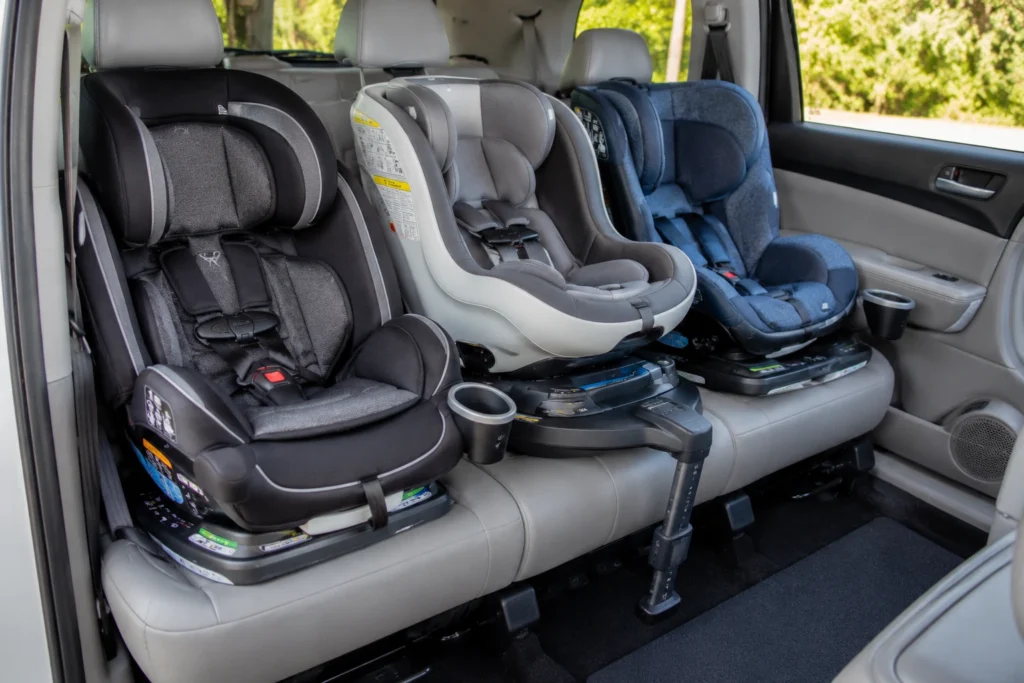
The swivel feature creates unique challenges. Because the seat rotates, it requires additional space to move. Consequently, neighboring seats can interfere with its motion when the installation becomes too tight. In some cases, parents discover that the seat technically fits but can no longer rotate properly. Naturally, that defeats the purpose.
Wide Bases
Many rotating seats use larger bases to support the swivel mechanism. Therefore, they occupy more valuable space.
Side-Wing Interference
Large side-impact wings may contact neighboring seats. As a result, spacing becomes more difficult.
Door Clearance Issues
Even when the rear bench is wide enough, the door opening may limit rotation. Consequently, accessibility can suffer.
Buckle Accessibility
Tight installations often make buckles harder to reach. Furthermore, older children may struggle to buckle themselves independently.
Key Measurements to Check Before Buying
Measurements are essential. In fact, they often determine success or failure before installation even begins. Planning a successful three-across setup requires careful measurement and spatial planning. In many ways, the process resembles solving a complex design problem where every inch matters. Similar principles of optimization can be found in Topology, which examines how spaces and dimensions interact under various constraints.
Measure Car Seat Width
Manufacturer specifications provide a helpful starting point. However, pay close attention to the widest point of the seat. Sometimes the widest section is the base. Other times it is the headrest. Either way, every inch matters.
Measure Rear Seat Width
Next, measure the available rear seating space. Record:
- Door-to-door width
- Cushion width
- Shoulder room
- Seat belt anchor spacing
Consequently, you’ll have a much clearer understanding of compatibility before purchasing.
Check Door Openings
A rotating seat requires sufficient clearance to swivel. Therefore, a vehicle may have adequate seat width yet still struggle with accessibility. This issue is especially common in compact vehicles. Accurate measurements are critical because small differences can significantly affect compatibility. Engineers frequently use concepts such as Dimensional analysis, when evaluating how measurements interact within a system. Similarly, comparing car seat dimensions carefully can help avoid costly purchasing mistakes.
Best Situations for Using a Rotating Car Seat in a Three-Across Configuration
Certain family situations work especially well with a rotating car seat for three across. Therefore, understanding these scenarios can help narrow your options faster.
One Rotating Seat Plus Two Narrow Seats
In most cases, this is the easiest configuration to achieve. Rather than using three wide seats, families often combine one rotating seat with two narrow models. As a result, they gain convenience without sacrificing valuable space. Example setup:
| Position | Seat Type |
|---|---|
| Driver Side | Narrow Convertible |
| Center | Rotating Seat |
| Passenger Side | Booster or Convertible |
Consequently, this arrangement often delivers the best balance between accessibility and fit.
Rotating Seat for the Youngest Child
Infants and toddlers typically require the most assistance. Therefore, placing the rotating seat where loading is easiest can dramatically improve daily routines. Furthermore, frequent buckling becomes less physically demanding.
Larger SUVs and Minivans
Although some sedans work well, larger vehicles generally provide more flexibility. For example:
- Minivans
- Full-size SUVs
- Select midsize SUVs
As expected, additional interior width often creates more installation possibilities.
Rotating Car Seat Features That Matter Most
When shopping for a rotating car seat for three across, certain features matter more than others.
Narrow Overall Width
First and foremost, width is critical. Even a single extra inch can determine whether three seats fit successfully.
Compact Rotating Base
Likewise, a smaller base often improves compatibility. Because the base occupies valuable space, compact designs typically perform better.
Adjustable Recline Positions
Additionally, flexible recline settings can improve positioning. Consequently, neighboring seats may fit more comfortably.
Extended Rear-Facing Limits
Many parents prefer keeping children rear-facing longer. Therefore, higher weight and height limits can provide additional long-term value.
Easy Installation System
Finally, installation simplicity matters. After all, even the best seat becomes frustrating if installation is overly complicated.
How to Plan a Successful Three-Across Arrangement
Success rarely happens by accident. Instead, a systematic approach produces the best results.
Step 1: Identify Your Children’s Needs
Start by documenting:
- Age
- Height
- Weight
- Current seat type
Subsequently, you can determine the most practical seat combination.
Step 2: Measure Your Vehicle
Next, gather accurate measurements. Without proper measurements, compatibility becomes largely guesswork.
Step 3: Prioritize Narrow Seats
Not every seat must rotate. Therefore, many families choose one rotating seat and two narrow models.
Step 4: Test Multiple Positions
Meanwhile, experiment with placement. Try:
- Center position
- Behind the driver
- Behind the passenger
Surprisingly, moving a seat just a few inches can dramatically change the overall fit.
Step 5: Verify Independent Installation
Most importantly, each seat must remain secure independently. if removing one seat affects another, adjustments may be necessary.
Common Three-Across Combinations
Different family situations call for different arrangements.
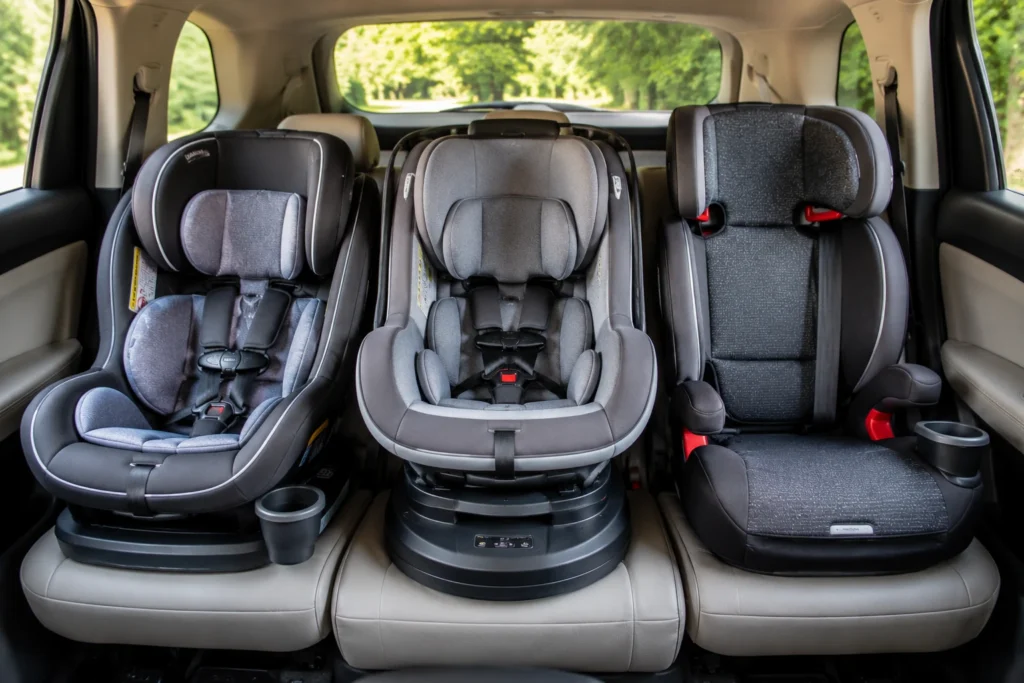
Rotating Seat + Convertible Seat + Booster
This combination works particularly well for families with children of varying ages.
Rotating Seat + Infant Seat + Convertible Seat
Meanwhile, growing families often favor this setup after welcoming a newborn.
Rotating Seat + Two Narrow Convertible Seats
Likewise, families with multiple toddlers frequently choose this arrangement.
Rotating Seat + Booster + Booster
Although less common, this setup may work for families with older children. Ultimately, the ideal configuration depends on your children’s ages and your vehicle’s dimensions.
Vehicle Types That Work Best
Vehicle choice can significantly influence success.
Minivans
Generally, minivans provide the most flexibility. Benefits include:
- Wider rear seating
- Larger door openings
- Easier access
Consequently, many parents consider them the easiest vehicles for three-across installations.
Full-Size SUVs
Similarly, full-size SUVs often offer generous seating dimensions.
Midsize SUVs
However, results can vary substantially. Therefore, measuring before purchasing remains essential.
Sedans
Even so, some sedans successfully accommodate a rotating car seat for three across when paired with carefully selected seats.
Safety Considerations
Convenience is important. Nevertheless, safety always comes first.
Follow Manufacturer Instructions
Every seat has unique installation requirements. Therefore, reading the manual thoroughly is critical.
Maintain Rotation Clearance
Likewise, the seat should rotate exactly as intended. If movement becomes restricted, reevaluate the setup.
Avoid Excessive Seat Interference
While light contact may be acceptable, excessive pressure can create installation concerns. Consequently, checking manufacturer guidance is essential.
Inspect Regularly
Over time, seats can shift. Therefore, periodic inspections help maintain proper installation.
Seek Professional Assistance
Whenever uncertainty exists, consult a certified Child Passenger Safety Technician. After all, expert guidance can prevent costly mistakes.
Common Mistakes Parents Make
Many installation problems stem from avoidable errors.
Buying Without Measuring
Unfortunately, this remains the most common mistake. Instead, always measure before purchasing.
Assuming Every SUV Works
Although SUVs appear spacious, interior dimensions vary considerably. Therefore, vehicle size alone should never determine compatibility.
Prioritizing Features Over Fit
Cup holders and luxury fabrics are appealing. However, proper fit matters far more.
Ignoring Booster Accessibility
Likewise, children need enough space to buckle themselves safely.
Ignoring Installation and Removal Requirements
Many parents focus only on initial installation. However, long-term usability matters too. For example, understanding How to Take Out the Evenflo 360 Car Seat can be just as important as learning how to install it properly, especially when transferring seats between vehicles.
Is a Rotating Car Seat Worth It for Three Across?
For many families, the answer is yes. On one hand, rotating seats offer exceptional convenience. On the other hand, they often require more planning. Benefits include:
- Easier loading
- Reduced physical strain
- Better accessibility
- Improved daily comfort
Potential drawbacks include:
- Higher cost
- Larger footprint
- Limited compatibility in smaller vehicles
Nevertheless, families who prioritize convenience often find the investment worthwhile.
Conclusion
A rotating car seat for three across can absolutely work. However, success depends on preparation. Therefore, measure carefully, compare dimensions, and test multiple seating arrangements before making a purchase. Furthermore, prioritize proper installation over extra features. Ultimately, the best setup is the one that fits your vehicle securely, accommodates your children comfortably, and supports safe everyday travel. With the right combination, a three-across configuration can be both practical and surprisingly convenient.
FAQs
Yes, many families successfully use a rotating car seat in a three-across configuration. The key is choosing compatible seats and measuring your vehicle carefully before purchasing.
Many rotating car seats are slightly wider because of their swivel mechanism. However, some newer models are compact enough to work in certain three-across arrangements.
The best position depends on your vehicle and the other seats being used. Many parents find that placing the rotating seat in the center or behind the passenger side provides the easiest access.
In some larger vehicles, it may be possible. However, most families have better success using one rotating seat alongside two narrower car seats.
No, many SUVs and some sedans can accommodate three car seats across. Proper measurements are more important than vehicle type alone.
Light contact may be acceptable depending on the vehicle and car seat manufacturers’ instructions. Always review both manuals to confirm compliance.
Many three-across setups work better with seat belt installations because they provide more flexibility in positioning. Always follow the car seat manufacturer’s recommendations.
Measure the rear seating area and compare those dimensions with the widths of the car seats you plan to use. Testing the seats in your vehicle before purchasing is ideal whenever possible.
Yes, but sufficient space must remain for the child to access the buckle independently. Tight installations can sometimes make buckling difficult.
For many parents, the convenience of easier loading and unloading justifies the higher price. It can reduce daily strain while making travel more comfortable for both parents and children.

