

This post contains affiliate links. As an Amazon Associate, 360 Car Seat earns from qualifying purchases, at no extra cost to you.
When I first heard about a car seat that turns 360, I immediately wondered why it hadn’t existed years earlier. Anyone who has wrestled a squirming toddler into a traditional car seat understands the struggle. You twist your back. Your shoulder hits the door frame. The buckle somehow disappears under your child’s leg. It’s not exactly a graceful process.
A car seat that turns 360 solves that problem in a surprisingly simple way. The seat rotates toward the car door, allowing parents to place or remove their child without leaning awkwardly into the vehicle. Then it rotates back and locks securely into a rear-facing or forward-facing position.
It sounds like a small change, but in daily life it makes a noticeable difference. In this guide, I’ll walk through how these rotating seats work, why many parents are switching to them, and what features you should look for before buying one.
What Is a 360-Degree Rotating Car Seat?
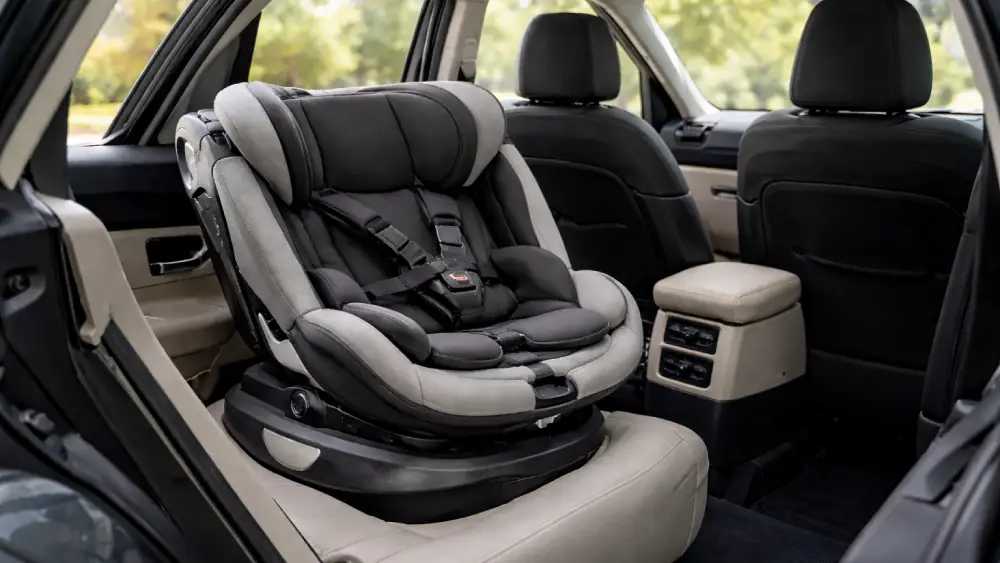
A car seat that turns 360 is exactly what it sounds like: a child car seat mounted on a rotating base that allows the seat to swivel toward the door for easier access. Once the child is secured, the seat rotates back into a safe travel position and locks in place.
The concept is simple, but the engineering behind it is carefully designed. The rotating mechanism sits within the seat’s base, which remains firmly installed in the vehicle using either the LATCH system or a seatbelt. The seat itself can then swivel smoothly without compromising stability.
This setup creates a significant usability advantage.
Traditional car seats require parents to lean into the vehicle while holding their child at an awkward angle. With a 360 rotating car seat, the seat faces outward while you buckle the harness. That small shift removes most of the twisting and lifting strain that parents deal with every day.
It’s also worth noting that not every rotating seat offers the same movement.
There are generally three categories:
- Fixed car seats – do not rotate at all
- 180-degree swivel seats – rotate partway toward the door
- 360-degree rotating seats – fully rotate for both rear- and forward-facing modes
A full car seat that turns 360 provides the most flexibility, particularly as children grow and transition between seating positions.
Key Benefits of a 360 Rotating Car Seat
The biggest advantage of a car seat that turns 360 is convenience, but the benefits go deeper than that. Over time, the design improves comfort, encourages safer seating positions, and simplifies everyday travel routines.
Easier Child Placement
This is the benefit parents notice immediately.
Instead of bending into the vehicle while holding your child, you simply rotate the seat toward the door. The child sits naturally in the seat, facing you, which makes buckling the harness far easier.
No awkward reaching.
No twisting your spine sideways.
Just place, buckle, and rotate.
Reduced Back and Shoulder Strain
If you install car seats daily, you understand how repetitive the motion becomes. Parents often lift children dozens of times each week while leaning into a car.
A 360 rotating car seat dramatically reduces that strain.
I’ve spoken with parents who say the rotating feature was the difference between dreading daycare drop-offs and barely thinking about them anymore. That’s especially important for parents recovering from childbirth or dealing with back pain.
Encourages Extended Rear-Facing
Rear-facing seats are widely considered the safest option for young children. However, many parents switch to forward-facing earlier than recommended simply because rear-facing seats are harder to manage.
A car seat that turns 360 removes that inconvenience.
Since the seat rotates toward the door, buckling a rear-facing child becomes just as easy as forward-facing. That encourages parents to keep their children rear-facing longer, which improves safety.
Better Harness Adjustments
Proper harness positioning matters.
When a seat rotates outward, parents can clearly see the straps and buckle. It becomes much easier to ensure the harness is snug and correctly aligned across the child’s shoulders and chest.
That small improvement can make a big difference in real-world safety.
Important Safety Features to Look For
Convenience is great. Safety is non-negotiable.
If you’re considering a car seat that turns 360, there are several critical safety features that deserve careful attention.
Side Impact Protection
Modern rotating seats often include advanced side-impact protection systems designed to absorb crash energy.
Look for features like:
- Energy-absorbing foam layers
- Reinforced outer shells
- Adjustable side headrests
These components work together to protect a child’s head and torso during collisions.
Secure Rotation Lock System
The rotating feature should never compromise stability.
A high-quality car seat that turns 360 includes a locking mechanism that firmly secures the seat in approved travel positions. The seat should not rotate freely once it’s locked.
Before buying, I always recommend testing the rotation mechanism in person if possible. It should feel solid and deliberate.
5-Point Harness System
Nearly all modern child seats use a five-point harness system, and for good reason.
The harness secures the child at five contact points:
- Two shoulders
- Two hips
- One between the legs
This distributes crash forces across stronger parts of the body and keeps the child properly positioned.
Load Leg or Anti-Rebound Bar
Some premium rotating seats include an additional stabilization feature called a load leg. It extends from the seat base to the vehicle floor, helping absorb crash forces.
Another option is an anti-rebound bar, which limits seat movement during rear-end collisions.
Not every seat includes these features, but they’re worth considering.
Safety Certifications
Every car seat sold in the United States must meet federal safety standards.
Specifically, look for compliance with FMVSS 213, the federal regulation governing child restraint systems. This ensures the seat has passed standardized crash testing.
Best 360 Rotating Car Seats
Several manufacturers now offer excellent rotating models. While I won’t claim there’s a single perfect seat, a few stand out consistently for safety, usability, and build quality.
| Model | Key Strength | Notable Feature |
| Evenflo Revolve360 | Very easy rotation | QuickClean fabric |
| Cybex Sirona S | Premium safety design | Load leg stabilization |
| Baby Jogger City Turn | Smooth rotation | Compact footprint |
| Maxi-Cosi Emme 360 | Comfort focused | Plush padding |
The Evenflo Revolve360 is one of the most widely recommended models. Its rotation mechanism is intuitive and locks securely into place.
The Cybex Sirona S leans more toward advanced safety engineering. Its load leg adds an extra layer of stabilization, which some parents find reassuring.
Meanwhile, the Baby Jogger City Turn focuses on compact design. That makes it a good choice for smaller vehicles where space matters.
No matter which option you choose, the key factor is how well the car seat that turns 360 fits your vehicle and your child’s needs.
Things to Consider Before Buying
Rotating seats offer impressive convenience, but not every model fits every family situation. Before purchasing a car seat that turns 360, I recommend thinking through a few practical considerations.
Vehicle Compatibility
Some rotating seats are larger than traditional models.
That extra space allows for the rotation mechanism, but it can also mean tighter fits in compact vehicles. Always check manufacturer compatibility guides before purchasing.
Weight and Height Limits
Children grow quickly.
Make sure the seat supports your child’s expected size for several years. Many rotating models accommodate children up to 40–50 pounds in rear-facing mode.
Installation Method
Car seats typically install using either:
- LATCH anchors
- Vehicle seatbelt systems
Most modern seats support both methods, but installation ease can vary widely between models.
Ease of Rotation
This sounds obvious, yet it matters.
Some rotating seats require two hands to unlock and swivel. Others rotate smoothly with one hand while holding your child with the other.
That difference becomes very noticeable during everyday use.
Price Range
A quality car seat that turns 360 typically costs between $300 and $600.
While that may seem expensive compared to basic seats, many parents find the added convenience well worth the investment.
Are 360 Rotating Car Seats Safe?
Yes. When properly installed and used according to manufacturer instructions, a car seat that turns 360 is just as safe as traditional car seats.
The key requirement is that the seat must lock securely in its designated travel position. The rotating feature itself is only used when loading or unloading a child.
Once locked into place, the seat functions exactly like any other certified child restraint system.
Proper installation remains the most important factor.
Even the best seat cannot protect a child effectively if it’s installed incorrectly. If possible, I recommend having your seat checked by a certified Child Passenger Safety Technician.
Many fire stations and hospitals offer this service for free.
Pros and Cons of Rotating Car Seats
Like any product, rotating car seats have both strengths and limitations.
Pros
- Easier child loading and unloading
- Reduced strain on parents’ backs
- Encourages extended rear-facing
- Better harness adjustments
Cons
- Higher price than traditional seats
- Heavier construction
- Slightly larger footprint in some vehicles
For many families, the convenience alone justifies the upgrade.
Tips for Using a 360 Car Seat Safely
Even the best car seat that turns 360 requires proper use. A few simple habits make a big difference.
- Always confirm the seat is locked before driving
- Keep your child rear-facing as long as possible
- Ensure harness straps are snug and positioned correctly
- Check installation tightness regularly
- Register the seat with the manufacturer for recall alerts
These small steps ensure the seat performs exactly as designed.
Final Thoughts
Parenting involves hundreds of small routines each week. Loading a child into the car is one of them, and it happens more often than we realize.
A car seat that turns 360 doesn’t reinvent child safety technology, but it improves how parents interact with it. That small design shift makes daily travel noticeably easier.
Less twisting.
Less lifting strain.
More convenient access.
For many parents, that combination makes rotating seats one of the most practical upgrades available today.
If you’re shopping for a new child seat, a 360 rotating car seat is absolutely worth considering!
Frequently Asked Questions
A car seat that turns 360 rotates toward the car door so parents can place and secure a child more easily before locking it into a travel position.
Most rotating seats can be used from infancy through toddler years, depending on the model’s weight and height limits.
Not always. Some models require more space due to the rotating base, so checking your vehicle’s compatibility is important.
Installation is usually similar to standard seats and uses either the LATCH system or a seatbelt.
Yes, most models are convertible and support both seating orientations as children grow.
They are often slightly heavier because of the built-in rotation mechanism and reinforced base.
No. The seat must always be locked into a rear-facing or forward-facing position before the vehicle moves.
Yes, many are designed to accommodate children for several years depending on manufacturer limits.
Many parents find the convenience and reduced physical strain make them a worthwhile investment.
Not usually. Regular cleaning and checking that the locking mechanism functions properly is typically enough.

