
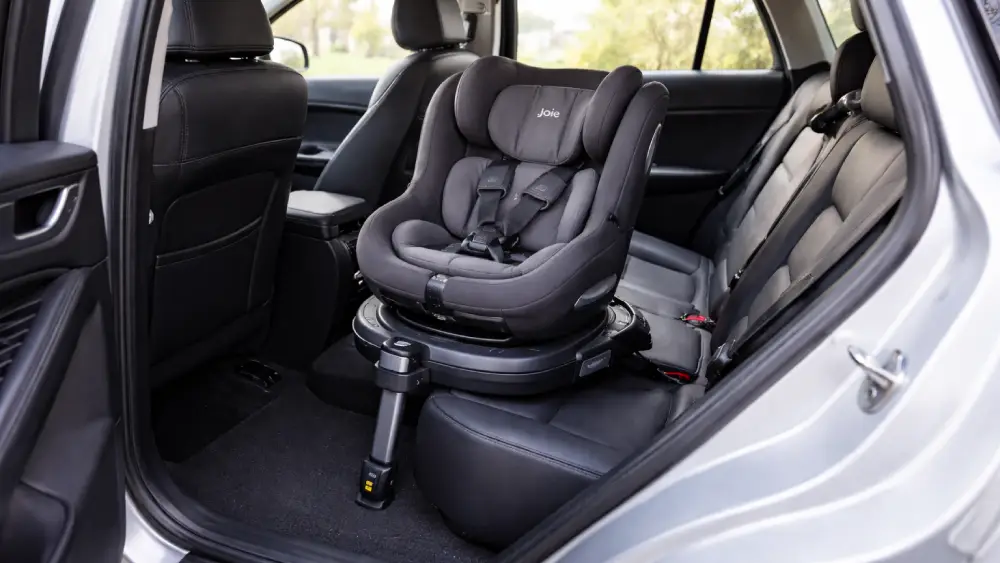

This post contains affiliate links. As an Amazon Associate, 360 Car Seat earns from qualifying purchases, at no extra cost to you.
Joie 360 car seat compatibility is one of those topics parents search at midnight, phone in hand, wondering if the seat they love will actually fit the car they drive. I’ve been there. The features look perfect. The rotation is brilliant. But will it install correctly? Will it leave enough legroom? Will it work in both cars?
These are not small questions. They’re safety decisions.
In this guide, we’ll break down Joie 360 car seat compatibility in practical, real-world terms—vehicles, ISOFIX, space requirements, stroller systems, legal standards, and common fitting challenges. Clear answers. No fluff.
What Is the Joie 360 Car Seat?
The Joie 360 range is built around one defining feature: full 360-degree rotation. You can turn the seat toward the door to load your child. Then rotate it rear-facing or forward-facing as needed. It’s convenient. It also reduces strain on your back.
Most models in the range are convertible seats. That means they’re designed to stay in the vehicle rather than click in and out like infant carriers.
Popular Joie 360 Models
Here’s a simplified comparison of the most common models and how they affect compatibility:
| Model | Regulation | Installation | Support Feature | From Birth? |
| Joie Spin 360 | R44 | ISOFIX | Support leg | Yes (with insert) |
| Joie i-Spin 360 | R129 (i-Size) | ISOFIX | Support leg | Yes |
| Joie i-Spin 360 E | R129 | ISOFIX | Support leg | Yes |
The key differences that impact Joie 360 car seat compatibility are:
- Whether your car supports ISOFIX
- Whether your vehicle floor allows a support leg
- The depth of your rear seat
Small technical differences can determine whether installation is rock solid—or impossible.
Vehicle Compatibility: What You Need to Know
This is where most parents get stuck.
ISOFIX: The Foundation
All Joie 360 models use ISOFIX connectors. That means:
- Your vehicle must have ISOFIX anchor points.
- You cannot install these seats using a standard seatbelt alone.
Most vehicles manufactured after 2013 have ISOFIX as standard. But do not assume. Open your vehicle manual. Look for ISOFIX labels at the base of the rear seats.
If your car does not have ISOFIX, Joie 360 car seat compatibility ends there.
The Support Leg Requirement
Unlike some seats that use a top tether, Joie 360 models rely on a support leg that extends from the base to the vehicle floor.
This matters more than many realize.
You need:
- A flat vehicle floor.
- No underfloor storage compartments (unless approved by the manufacturer).
- Adequate vertical clearance.
If your car has hidden storage under the rear footwell, check whether it’s reinforced. Some manufacturers provide filler blocks. Others prohibit support legs entirely in that position.
No stable support leg means no safe install. Simple as that.
Space Requirements: The Reality Check
Rear-facing seats take space. Rotating seats take more.
In compact hatchbacks, you may find:
- Reduced front passenger legroom.
- Limited recline adjustment.
- Tight clearance when rotating.
In SUVs or sedans, compatibility is generally easier—but still check depth and seat angle.
If possible, measure:
- Rear seat depth (front to back).
- Height from seat cushion to ceiling.
- Distance between front and rear seats.
Bring those numbers when checking Joie 360 car seat compatibility against the manufacturer’s dimensions.
How to Check If Joie 360 Fits Your Car
Guessing is not a strategy. Testing is.
1. Use the Official Joie Vehicle Fit List
Joie provides a compatibility list by model and vehicle. This should be your starting point. Search for your exact car:
- Year
- Trim level
- Body style
A 2018 sedan may differ from a 2018 hatchback in fit.
If your vehicle appears as “semi-universal,” read the notes carefully. It may only fit in specific seating positions.
2. Do a Physical Test Fit
Nothing replaces a real installation test.
When test fitting:
- Extend ISOFIX arms fully and click in firmly.
- Check the support leg sits flat with the correct indicator showing green.
- Confirm the seat does not move more than 2 cm side to side.
- Rotate the seat fully in both directions.
Try sitting in the front passenger seat afterward. If knees hit the dashboard, reconsider.
3. Be Cautious With Online Retailer Tools
Some retailers offer “fit check” tools. These are helpful—but not definitive.
They rarely account for:
- Floor storage compartments.
- Seat contour differences.
- Aftermarket seat covers.
- Leather vs. fabric compression.
Use them as guidance, not proof of Joie 360 car seat compatibility.
Joie 360 Stroller Compatibility
Let’s address a common misconception.
The Joie 360 range is not a travel system infant carrier. It does not clip onto strollers.
Parents often assume any seat from the same brand will integrate. It won’t.
Joie 360 car seat compatibility applies strictly to vehicle installation—not stroller attachment.
If you need a travel system:
- Use a Joie infant carrier (e.g., Joie i-Level, Joie Gemm).
- Pair it with a compatible Joie stroller.
- Transition to a 360 seat later when your child outgrows the carrier.
Convertible rotating seats are designed to stay installed. Removing them daily defeats the purpose.
Common Compatibility Concerns
This is where practical questions surface.
Small Cars and Limited Space
If you drive a compact car, focus on:
- Recline angle adjustment.
- Whether front seats can slide forward safely.
- Door clearance for rotation.
Pro tip: install behind the passenger seat. It’s easier to sacrifice passenger legroom than driver positioning.
Fitting Multiple Car Seats
Trying to fit two or three seats across?
Measure width carefully.
The Joie Spin 360 base is wider than many non-rotating seats. You may struggle with three-across setups in smaller sedans.
When evaluating Joie 360 car seat compatibility in multi-seat households:
- Install the widest seat first.
- Test door closing clearance.
- Confirm seatbelt buckles remain accessible.
Spacing becomes tight quickly.
Switching Between Cars
ISOFIX makes transfer easier—but not effortless.
You must:
- Fully retract ISOFIX arms.
- Reset support leg height.
- Reconfirm green indicators every time.
Frequent transfers increase the chance of improper installation. If you use two vehicles daily, consider two seats.
Safety favors stability.
Safety and Legal Compatibility
Regulations influence compatibility more than many realize.
R44 vs. R129 (i-Size)
The newer R129 standard focuses on:
- Height-based sizing.
- Enhanced side-impact testing.
- Mandatory rear-facing up to at least 15 months.
If your vehicle is labeled i-Size ready, compatibility with R129 seats is generally straightforward.
However, older cars may not be officially “i-Size approved,” even if ISOFIX is present. Always cross-check.
Rear-Facing Laws
Many countries require rear-facing travel until at least 15 months. Some safety bodies recommend longer—up to 4 years.
Before rotating forward-facing, confirm:
- Legal requirements.
- Manufacturer minimums.
- Child height and weight thresholds.
Joie 360 car seat compatibility isn’t only about physical fit. It’s also about legal and safety alignment.
Final Thoughts: Choosing the Right Fit
Joie 360 car seat compatibility comes down to five key checks:
- ISOFIX availability
- Support leg floor stability
- Rear seat depth
- Passenger legroom
- Legal regulation alignment
It’s easy to focus on rotation and convenience. Those features matter. But fit matters more.
If you’re serious about safety—and I assume you are—test before you commit. Measure twice. Install once. Rotate smoothly. Drive confidently.
Because when the seat fits properly, everything feels different. Secure. Stable. Certain.
And that peace of mind? Worth every minute spent checking compatibility.
Frequently Asked Questions
Check your vehicle manual for ISOFIX anchors and confirm your car appears on Joie’s official compatibility list.
Yes, compact cars may limit front seat space and rotation clearance, so a physical test fit is recommended.
No, all Joie 360 models require ISOFIX connectors and cannot be installed using a seatbelt alone.
The support leg must sit flat on a solid floor without unsupported storage compartments underneath.
Yes, some vehicles with underfloor compartments may not safely support the leg unless reinforced.
Yes, but you must reinstall and check ISOFIX and support leg indicators each time you move it.
It depends on your vehicle width, as rotating bases can make three-across installations difficult.
No, it is a fixed convertible seat and does not attach to strollers like infant carriers do.
Some models meet R129 (i-Size) standards, but you should verify your exact model and vehicle approval.
Follow your local laws and the manufacturer’s height and weight limits before rotating forward-facing.

