
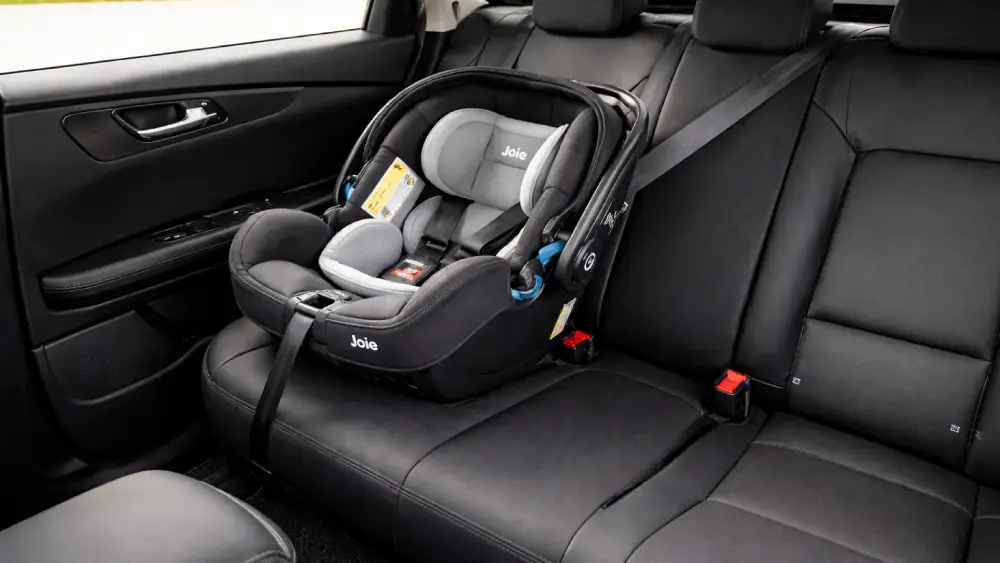
If you’re researching a Joie baseless car seat, you’re likely trying to balance safety, cost, and flexibility without overcomplicating your setup. I’ve worked with many parents who assume they need an ISOFIX base to keep their baby secure. That’s not always true. A Joie baseless car seat can offer the same regulated safety standards when installed correctly—while giving you more freedom, especially if you switch vehicles often or travel regularly.
In this guide, I’ll walk you through exactly what “baseless” means, which Joie models support it, how to install one properly, and when it’s the smarter choice over a base system. Let’s get into it.
What Is a Baseless Car Seat?
A baseless car seat is an infant carrier installed directly using your vehicle’s seat belt instead of clicking into a separate base unit. It remains rear-facing, just like a base-installed infant seat. The difference lies entirely in the installation method.
With a base system, you install the base once using ISOFIX connectors or a seat belt, then click the carrier in and out. With a Joie baseless car seat, you secure the carrier itself every time using the vehicle’s seat belt routing guides built into the seat.
Is it safe? Yes—if installed correctly. Joie seats that allow baseless installation still meet European ECE R44 or R129 (i-Size) standards. Those certifications don’t change depending on whether you use the base.
The key variable isn’t the hardware. It’s the installation quality.
Why Choose a Joie Baseless Car Seat?
There are three main reasons I recommend considering a Joie baseless car seat.
1. Flexibility Across Vehicles
If you regularly switch between cars—yours, your partner’s, a grandparent’s, or taxis—carrying a separate base becomes inconvenient fast. Installing baseless takes a few extra minutes, but it removes the need to buy and manage multiple bases.
For city families, this matters.
2. Budget Efficiency
Buying an infant seat plus ISOFIX base increases the total cost significantly. Choosing a Joie baseless car seat setup can reduce upfront expense while maintaining regulatory safety compliance. That’s not cutting corners—it’s eliminating an accessory.
3. Travel Convenience
If you travel by air or rely on ride-share services, hauling a base through airports isn’t practical. A baseless seat gives you portability. Lightweight. Self-contained. Adaptable.
Joie has built a reputation for offering strong safety performance at accessible price points. They don’t rely on luxury branding. They focus on function.
Popular Joie Models That Work Without a Base
Not every infant seat on the market allows baseless installation. Fortunately, several Joie models are designed specifically to support it.
Joie Juva
The Joie Juva is one of the brand’s most lightweight infant carriers. It typically supports babies from birth up to around 13 kg (depending on regional specifications).
What I like about it:
- Extremely lightweight shell
- Clear belt routing guides
- Side impact protection panels
- Compatible with Joie strollers
This is often the most budget-conscious option for parents who want a straightforward Joie baseless car seat without unnecessary add-ons.
Joie Gemm
The Gemm offers enhanced side impact protection compared to entry-level models. It’s also suitable from birth and compatible with multiple Joie pushchairs.
Why parents choose it:
- Thicker padding
- Adjustable head support
- Stronger side-impact structure
- Smooth travel system integration
If you want a mid-tier Joie baseless car seat that feels more substantial while remaining portable, the Gemm is a solid option.
Joie i-Gemm (i-Size)
The i-Gemm complies with R129 (i-Size) regulations in many markets. That means improved side-impact testing standards and height-based sizing rather than weight-only guidance.
It can often be installed both with and without a base, depending on configuration.
Best for:
- Parents prioritizing newer safety regulation standards
- Smaller vehicles
- Travel systems with upgraded safety specs
Here’s a quick comparison snapshot:
| Model | Weight/Height Range | Safety Standard | Approx. Seat Weight | Best For |
| Juva | Birth–13 kg | ECE R44 | Very lightweight | Budget & travel |
| Gemm | Birth–13 kg | ECE R44 | Lightweight | Extra side protection |
| i-Gemm | Height-based (R129) | R129 (i-Size) | Moderate | Updated safety standards |
Always confirm regional specifications before purchasing. Regulations vary slightly by country.
How to Install a Joie Baseless Car Seat Correctly
Installation is where confidence matters most. A Joie baseless car seat is only as safe as the tightness and accuracy of the belt routing.
Here’s the process I recommend:
- Place the seat rear-facing on the vehicle seat.
- Thread the seat belt through the designated blue belt guides (check your specific model).
- Buckle the seat belt.
- Lock the belt if your vehicle requires it (many modern belts lock automatically when fully extended).
- Apply downward pressure while tightening the belt.
- Check movement—less than one inch side-to-side at the belt path.
That final step is critical.
Common Installation Mistakes
- Twisted seat belts reducing tension strength
- Routing the belt through the wrong guide
- Forgetting to lock the retractor
- Not checking recline angle
If the seat tilts too upright, newborn airway positioning can be compromised. Most Joie infant seats include visual recline indicators. Use them.
When in doubt, consult a certified child passenger safety technician. It’s worth the peace of mind.
Pros and Cons of a Joie Baseless Car Seat
Let’s be realistic. There are trade-offs.
Pros
- Lower upfront cost
- No need to purchase additional bases
- Easier for travel and taxis
- Lightweight and portable
- Compatible with many strollers
Cons
- Slightly longer installation time each use
- More room for user error if rushed
- Not as convenient for daily click-in commuting
If you drive the same car every day and prioritize speed above all else, a base may feel smoother. If flexibility matters more, the Joie baseless car seat wins.
Baseless vs ISOFIX Base: Which Is Better?
I’m often asked whether ISOFIX is inherently safer.
The honest answer? Not necessarily.
Both methods meet safety standards when installed properly. ISOFIX reduces installation error by simplifying the connection. That’s its main advantage.
Let’s compare:
Convenience:
Base systems are faster for daily in-and-out routines.
Safety:
Equal when installed correctly.
Cost:
Baseless is more affordable.
Flexibility:
Baseless works in nearly any vehicle with seat belts.
If you frequently switch vehicles, a Joie baseless car seat provides greater versatility without sacrificing compliance.
Travel and Everyday Scenarios Where Baseless Shines
Some lifestyles naturally benefit from baseless installation.
- Urban families using taxis
- Parents sharing custody and switching cars
- Grandparents occasionally transporting baby
- International travel with rental cars
In these situations, lugging and reinstalling multiple bases becomes impractical. A Joie baseless car seat simplifies logistics.
And simplicity reduces stress
Final Verdict: Is a Joie Baseless Car Seat Worth It?
In my experience, a Joie baseless car seat is worth serious consideration if flexibility and value matter to you. It provides regulated safety, strong side-impact protection in many models, and genuine portability. That combination is powerful.
It’s not about skipping safety features. It’s about choosing the right configuration for your lifestyle.
If you drive one car daily and want maximum convenience, a base may make sense. But if you travel, switch vehicles, or want to control costs without compromising compliance, the Joie baseless car seat is a practical, confident choice.
Safety isn’t defined by accessories. It’s defined by correct installation, thoughtful use, and informed decision-making.
And when you approach it that way, you’re already doing it right.
Frequently Asked Questions
Yes, a Joie baseless car seat meets the same safety standards when installed correctly using the vehicle seat belt.
Most vehicles with standard 3-point seat belts can accommodate it, but always check both the car and seat manual.
It can take a few extra minutes, especially at first, but it becomes quicker with practice.
Models like the Joie Juva, Gemm, and some i-Gemm versions typically support baseless seat belt installation.
Yes, it’s ideal for taxis since you don’t need to carry or install a separate base.
Absolutely, as long as you ensure a tight and correct installation each time.
It should move less than one inch side-to-side at the belt path.
Many are approved for aircraft use, but you should confirm approval labeling and airline policies beforehand.
No, side-impact protection is built into the seat itself, not the base.
Transition once your child exceeds the seat’s height or weight limit as specified in the manual.