
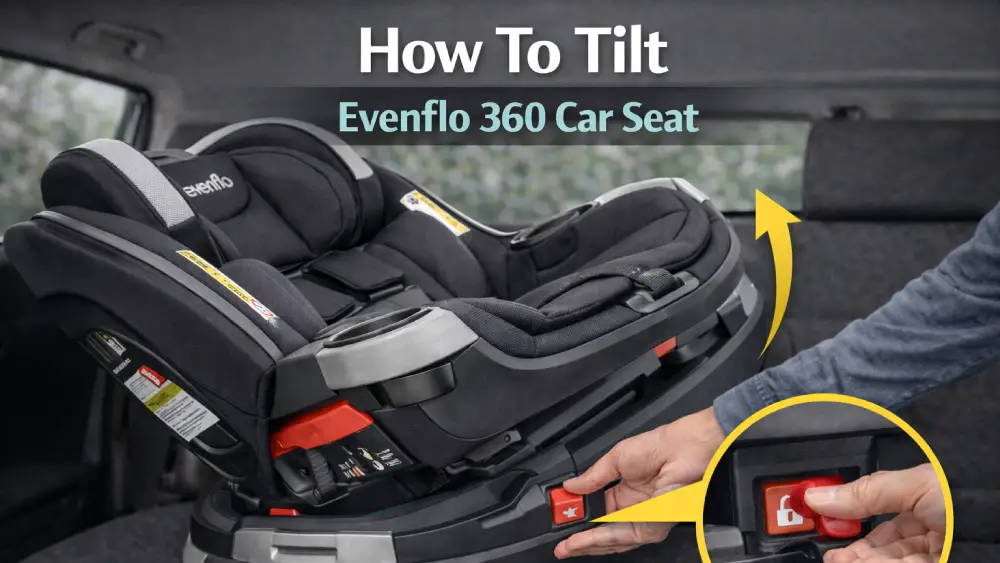
Tilting a car seat isn’t a comfort feature. It’s a safety requirement. With a rotating model like the Evenflo 360, the tilt (recline) angle plays a critical role in head support, breathing alignment, and crash protection. Knowing how to tilt Evenflo 360 car seat correctly ensures the seat performs exactly as it’s designed to.
Many parents confuse tilt with rotation. They look similar but serve very different purposes. This guide explains how the tilt system works, when adjustments are necessary, and how to confirm everything is set correctly before driving.
Let’s walk through it.
Understanding Tilt vs Rotation on the Evenflo 360
The Evenflo 360 has two separate adjustment systems:
- Rotation: Allows the seat to swivel toward the door for easier loading
- Tilt (recline): Sets the seat’s angle for safe travel
Rotation is for convenience. Tilt is for safety. One does not replace the other.
When You Need to Adjust the Tilt
Tilt adjustments are required more often than many parents realize.
You should adjust or recheck tilt:
- During first-time installation
- When switching between rear-facing and forward-facing
- After reinstalling the seat in another vehicle
- If the recline indicator moves out of range
Tilt should never be adjusted based solely on comfort.
How To Tilt Evenflo 360 Car Seat (Step by Step)
Follow these steps carefully to set the correct angle.
Step 1: Confirm the seating mode
Check whether the seat is installed rear-facing or forward-facing. Approved tilt positions differ for each mode.
Step 2: Locate the tilt handle
The tilt (recline) handle is located at the front base of the seat. This control unlocks the preset tilt positions.
Step 3: Pull the tilt handle
Pull the handle firmly and hold it to release the tilt lock.
Step 4: Adjust the seat angle
While holding the handle:
- Push the seat backward to increase tilt
- Pull the seat forward to make it more upright
Release the handle once the seat clicks into place.
Step 5: Check the recline indicator
Use the built-in recline indicator to confirm the seat is within the approved tilt range for your child’s mode.
If the indicator is outside the range, readjust before driving.
Rear-Facing Tilt Guidelines
Rear-facing tilt is especially important for infants and young toddlers.
Key points to follow:
- Use the most reclined approved position for newborns
- Keep the indicator within the marked range
- Avoid adding towels or pool noodles unless explicitly allowed by the manufacturer
Correct tilt supports proper head and airway positioning.
Forward-Facing Tilt Guidelines
Forward-facing tilt is more upright but still regulated.
Important rules:
- Use only manufacturer-approved forward-facing tilt positions
- Always use the top tether
- Ensure the tilt does not loosen tether tension
Over-tilting forward-facing can reduce crash protection.
Common Tilt Mistakes to Avoid
These issues show up frequently:
- Confusing rotation with tilt
- Ignoring the recline indicator
- Adjusting tilt after tightening without rechecking
- Using an unapproved angle
Small missteps can affect safety.
How To Confirm the Tilt Is Correct
Before every drive:
- Check the recline indicator
- Confirm the seat is locked in a travel position
- Test for less than one inch of movement at the base
If the indicator shifts after tightening, re-adjust and secure again.
Troubleshooting Tilt Issues
If the seat won’t tilt properly:
- Slightly loosen the installation
- Adjust tilt first
- Retighten and recheck
Never force the tilt handle or the seat itself.
Final Thoughts
Knowing how to tilt Evenflo 360 car seat correctly helps ensure your child rides safely through every stage. Tilt is not optional. It’s a built-in safety feature that works alongside the harness, recline indicator, and rotation lock.
Take a moment during installation and recheck as your child grows. Those few seconds make a real difference.
Frequently Asked Questions
No, tilting adjusts the recline angle for safety, while rotation turns the seat for easier loading.
The tilt handle is located at the front base of the seat.
Use the built-in recline indicator to confirm the seat is within the approved range for your seating mode.
Yes, rear-facing positions are more reclined to support proper head and airway alignment.
Yes, but you should always recheck the recline indicator and seat tightness afterward.
Tilt should be adjusted before final tightening, then verified once the seat is secure.
You can adjust it for access, but the seat must be locked into a travel position before driving.
Stiff movement often means the seat is installed too tightly or not aligned properly.
Yes, tilt settings may change when switching between rear-facing and forward-facing modes.
Tilting is primarily a safety feature designed to ensure proper positioning during a crash.