Let’s get straight to it: when can baby face forward in Joie 360 car seat is one of the most common questions parents ask once the newborn stage starts fading and your little one begins to look… well, less little. And I get it. Rear-facing feels like it lasts forever. Your child looks bigger. Their legs look bent. Friends start saying, “We turned ours already.”
But here’s the truth. The safest choice often isn’t the quickest choice. And the Joie 360 line—especially the i-Size versions—was built with that safety-first mindset in mind.
This article will give you a clear answer, plus the practical details that actually matter: age requirements, height and weight rules, model differences, and how to switch safely without second-guessing every click and strap. Let’s do this.
Rear-Facing vs. Forward-Facing: What You’re Really Choosing
Rear-facing isn’t a parenting trend. It’s physics.
When a crash happens, your child’s body doesn’t politely slow down. It keeps moving. Their head moves most of all because it’s large and heavy compared to the rest of their body, especially in the toddler years.
Rear-facing seats are designed to catch the head, neck, and spine together. Like a supportive cradle. Forward-facing seats rely more heavily on the harness to stop the body, which puts more stress on the neck.
That’s the big difference.
Rear-Facing (The Safer Default)
Rear-facing supports:
- Head
- Neck
- Spine
…as one unit during a sudden impact.
Forward-Facing (A Necessary Stage, Just Not a Rushed One)
Forward-facing:
- Works well when your child is developmentally ready
- Still uses a 5-point harness
- Is the standard step before boosters later on
But it’s not “the upgrade.” It’s just the next stage.
And you don’t get a medal for switching early. You just get more risk.
Quick Overview: What Is the Joie 360 Car Seat?
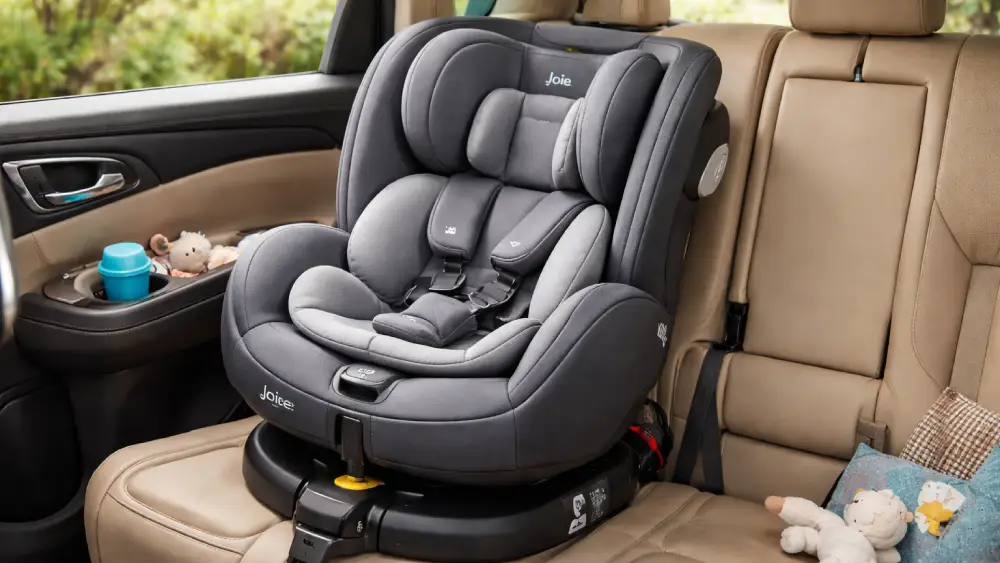
Joie’s 360-degree rotating seats are popular for one simple reason: they make daily life easier.
You can rotate the seat toward the car door, buckle your child without twisting your back into a question mark, then rotate it back into position. That’s not just convenient. It reduces user error too.
Because when parents are exhausted, complicated steps get skipped.
Common Joie 360 Models Parents Use
You’ll usually see variations like:
- Joie Spin 360
- Joie i-Spin 360
- Joie i-Spin Safe
- Joie i-Spin Grow (in some markets)
The names vary by country, but the idea is consistent: rotation + safety + extended rear-facing options.
So… When Can Baby Face Forward in Joie 360 Car Seat?
Here’s the clearest answer I can give without fluff:
Most Joie 360 i-Size models allow forward-facing from 15 months minimum (and within the required height range).
Not 12 months. Not “when they look ready.”
15 months is the minimum for many Joie 360 i-Size seats, and some models even include a built-in lock that prevents forward-facing before that age.
That said, minimum doesn’t mean best. It just means allowed.
And yes, you still need to meet the height requirement too.
The Real Requirements: Age, Height, and Weight (Without Confusion)
The tricky part is that Joie 360 seats come in different standards depending on where you bought them.
Some are based on:
- i-Size (R129): uses height + age rules
- Older ECE R44/04: uses weight rules like “9–18 kg”
This is why parents get mixed advice online. They’re reading different manuals.
A Practical Cheat Sheet (General Guidance)
| Direction | Typical Minimum | Typical Maximum | Notes |
| Rear-facing | Birth | 105 cm (or 18 kg) | Best to max out rear-facing limits |
| Forward-facing | 15 months + | 105 cm (or 18 kg) | Must meet minimum height/age too |
Important: Your seat’s label and manual always win. Always.
But if you’re asking the question “when can baby face forward in Joie 360 car seat,” you’re almost certainly looking at the 15-month rule.
Why the 15-Month Rule Exists (And Why It’s Not Random)
Fifteen months isn’t a magic number. It’s a safety line.
Before that age, your child’s neck is still developing fast. Their vertebrae are softer. Their head is still proportionally heavy. In a forward-facing crash, the forces can pull the head forward with more strain than their body can handle.
Rear-facing dramatically reduces that load.
That’s why many i-Size seats require rear-facing until 15 months minimum.
And honestly? If your child is doing great rear-facing at 2 years, 3 years, or close to 4 years… that’s even better.
The Best Practice: Keep Rear-Facing as Long as Possible
This is the part that makes some parents sigh.
Because yes, rear-facing is inconvenient sometimes.
But the safety payoff is huge.
Why delaying forward-facing matters
- Front crashes are the most common serious crashes
- Rear-facing spreads crash force across the seat shell
- Your child’s head and spine stay aligned
In plain terms: rear-facing is the seat doing the heavy lifting.
Forward-facing asks your child’s body to do more of it.
And that’s not a fair job to give a toddler.
Signs Your Child Is Ready to Face Forward (The Right Way to Decide)
Let’s make this practical. Because you’re busy.
You shouldn’t have to read 43 forum threads to feel confident.
Your child is “ready” to face forward if:
- They are at least 15 months old (for most Joie i-Size models)
- They meet the minimum height required for forward-facing
- They are still within the seat’s forward-facing limits
- You can position the harness correctly (more on that soon)
- Rear-facing limits are being approached (height or weight)
Your child is not ready just because:
- Their legs look bent
- They seem bored
- They want to see you
- They cry sometimes
- Someone else turned their child earlier
Bent legs are normal. Kids are flexible. They sit cross-legged on purpose!
Rear-facing discomfort is often a “grown-up discomfort,” not a child one.
“But Their Legs Look Cramped!” — Let’s Talk About That
This is the #1 emotional reason parents want to switch.
I understand it. It looks uncomfortable.
But kids don’t experience leg position the same way adults do. They naturally sit in odd positions for fun. They rest their feet on the seat back like they own the place.
Also, forward-facing introduces a different risk: in a crash, legs can fly forward with more force.
So if your child’s legs look cramped rear-facing, that’s not a safety problem. It’s just a visual one
Model Differences: Joie Spin 360 vs. i-Spin 360 (Why It Matters)
Not every Joie 360 seat has identical rules.
Some allow forward-facing earlier by weight (older regulation), while i-Size seats are stricter with age and height.
The best way to check your exact seat
Look for:
- The label on the side of the seat
- The manual (paper or PDF)
- i-Size marking: “R129” or “i-Size”
If your seat is i-Size, you’re almost certainly dealing with the 15-month minimum.
So again, when can baby face forward in Joie 360 car seat?
Usually: 15 months minimum + correct height range.
The “Smart Ride” Lock: Why Your Seat Might Not Let You Turn Yet
Some Joie models include a safety feature that physically prevents forward-facing until your child reaches the minimum age.
This is a good thing.
It’s the seat politely saying: “Not yet.”
If you’ve tried rotating it and thought something was broken, it might just be doing its job.
How to Switch to Forward-Facing in a Joie 360 (Step-by-Step)
This is where many parents mess up. Not because they don’t care. Because switching feels deceptively simple.
Rotation seats can make you think:
“Cool, just spin it around!”
But forward-facing requires correct setup. Every time.
Step 1: Confirm Your Child Meets Requirements
Before anything else:
- 15 months minimum (for i-Size models)
- Minimum height requirement met
- Within forward-facing limits
This step matters more than the actual turning.
Step 2: Rotate the Seat into Position
- Rotate the seat until it clicks into the forward-facing lock position
- Make sure it is fully locked (not halfway)
If it’s not locked, it’s not safe.
Step 3: Check ISOFIX Indicators
If your Joie 360 uses ISOFIX, check the indicators:
- Many models show green when secure
- Red means something isn’t engaged properly
This is a fast win. Take the two seconds.
Step 4: Adjust the Recline for Forward-Facing
Some seats require a different recline angle when forward-facing.
Don’t assume the recline you used rear-facing is correct.
It often isn’t.
Step 5: Harness Height Must Change
This is critical.
Rear-facing harness straps should typically come at or below the shoulders.
Forward-facing straps should come at or above the shoulders.
If you forget this, the harness won’t restrain correctly in a crash.
The Harness Fit Checklist (This Saves Lives)
I’m going to be blunt here: most car seat misuse happens at the harness.
It’s not the ISOFIX. It’s not the rotation.
Here’s what to do every single time.
Harness Fit Rules
- Chest clip at armpit level
- Straps lie flat (no twists)
- Harness passes the pinch test
- Shoulder straps positioned correctly for direction
- Coat removed (yes, really)
The Pinch Test
Try to pinch the strap at the shoulder.
If you can pinch fabric, it’s too loose.
Tighten until you can’t pinch.
Simple. Fast. Effective.
Common Parent Questions (Answered Clearly)
1) Can I turn my baby forward-facing at 12 months in a Joie 360?
For most i-Size Joie 360 seats, no. The minimum is typically 15 months.
2) My child meets the weight limit. Does that mean they can face forward?
Not always. i-Size seats use height and age rules more heavily.
3) What if my child hates rear-facing?
This is common around toddlerhood. Try:
- A mirror (if allowed and safely installed)
- More snacks (strategic snacks!)
- A calmer loading routine
- Better timing (some kids hate being buckled when overtired)
But don’t switch direction purely to stop crying.
4) Does Joie recommend rear-facing longer than 15 months?
Yes, most guidance supports rear-facing as long as possible within the seat limits.
5) What if my child’s head is close to the top?
That’s a real sign you may be approaching the rear-facing limit.
Check your manual for:
- Maximum height
- Head position rule (some seats require a certain clearance)
A Simple Decision Framework (Use This and Stop Overthinking)
Here’s a straightforward way to decide.
If any of these are true, stay rear-facing:
- Child is under 15 months (for i-Size Joie 360)
- Child is under minimum forward-facing height
- Child still fits rear-facing limits comfortably
- Harness fits well rear-facing
Consider forward-facing only when:
- Child is 15 months+
- Child meets height rules
- Rear-facing limits are being approached
- You can set the harness correctly in forward-facing mode
This isn’t about rushing. It’s about timing.
Safety Tips That Actually Matter (And Are Easy to Do)
You don’t need to become a car seat technician. But you do need a few habits.
High-impact safety habits
- Check the harness fit every ride
- Re-check ISOFIX monthly
- Avoid thick winter coats in the seat
- Keep the manual accessible (phone photo works!)
- Replace the seat after a moderate or severe crash
Also: register your seat if your country offers registration for recalls.
It takes two minutes.
And it’s one of the most underrated safety steps.
Summary Table: The Quick Answer You Came For
| Question | Best Answer |
| When can baby face forward in Joie 360 car seat? | Usually 15 months minimum (i-Size) + meets height requirement |
| Is it safer to stay rear-facing longer? | Yes, strongly |
| Is leg bending a reason to switch? | No |
| What matters most when switching? | Correct harness height and fit |
Final Thoughts (And My Honest Recommendation)
If you came here asking when can baby face forward in Joie 360 car seat, I want you to leave with confidence, not anxiety.
Here’s the simple takeaway:
Most Joie 360 i-Size seats allow forward-facing from 15 months minimum, assuming your child meets the height and seat requirements. But the safest approach is to keep rear-facing as long as your seat allows, ideally up to the maximum limits.
It’s not about being strict.
It’s about being smart.
And the Joie 360 makes it easier than most seats to do the safe thing without breaking your back in the process.
Frequently Asked Questions
Most Joie 360 i-Size models allow forward-facing from 15 months, as long as your child also meets the height requirement.
Yes—rear-facing offers better head, neck, and spine protection, especially in frontal crashes.
Usually no, because many Joie 360 i-Size seats require rear-facing until at least 15 months.
Yes, i-Size Joie 360 seats use height ranges, so your child must meet both the minimum age and height.
That’s normal and not a safety concern—toddlers are flexible and often sit comfortably with bent legs.
Some models do, and it’s designed to stop forward-facing use before your child reaches the minimum age.
Check your manual for the maximum height/weight limits and any head clearance rules for your specific model.
The straps should sit at or slightly above your child’s shoulders for the best fit and restraint.
No—bulky clothing can prevent the harness from tightening properly and reduce safety in a crash.
Not usually—try comfort adjustments first, because rear-facing is still the safer option if your child fits.