
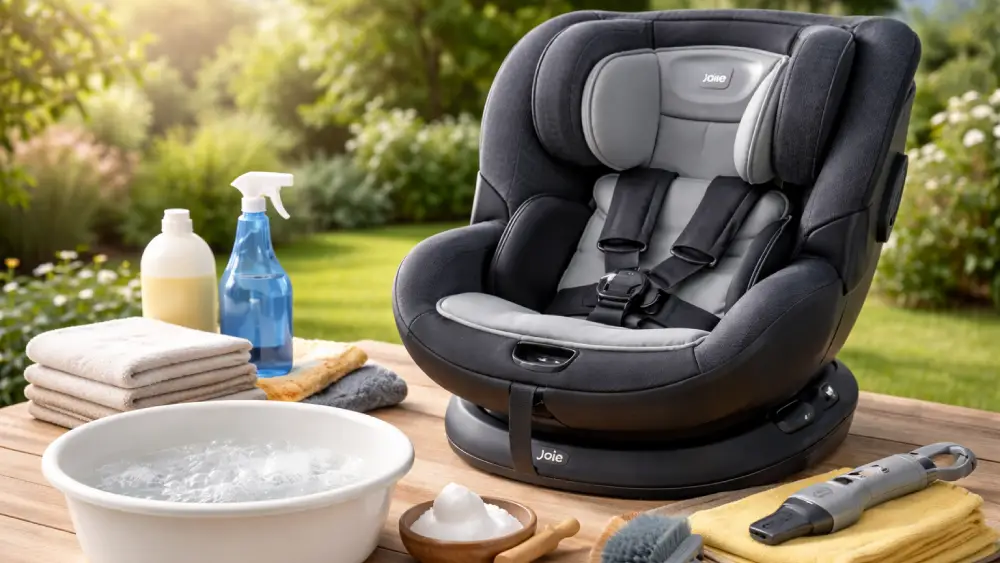
Let’s be honest. A Joie 360 car seat is one of the best inventions ever made for parents… right up until the first snack explosion happens. Then it becomes a rotating crime scene. And if you’re here, you already know why you’re searching how to wash Joie 360 car seat—because something happened. Something sticky. Something you never want to identify.
Good news: you can clean it thoroughly without damaging the fabric, weakening the harness, or messing up the 360 rotation mechanism. Better news: it’s not as hard as it looks. You just need a smart approach, a few basic supplies, and the patience to let things dry properly.
I’ll walk you through it step by step, like a real person would. No guesswork. No risky shortcuts.
Before You Start: Read This First (Seriously)
If you take one thing from this guide on how to wash Joie 360 car seat, let it be this:
Car seats are safety equipment first.
Cleaning comes second.
That means your goal is not just “make it look new.” Your goal is “clean it while keeping it safe.”
The 3 Rules You Should Not Break
- Do not machine wash the harness straps.
- Do not soak foam parts or internal padding.
- Do not use harsh cleaners like bleach, disinfectant sprays, or degreasers.
A Joie 360 car seat has materials that look like regular fabric and plastic, but some parts are engineered to handle crash forces. Treat it accordingly.
What You’ll Need (Simple, No Fancy Stuff)
Here’s the setup I recommend. It’s practical and fast.
| Item | Why You Need It |
| Vacuum with crevice tool | Crumbs hide everywhere |
| Mild detergent (baby-safe is ideal) | Strong soap can damage fabric coatings |
| Warm water | Helps lift grime without harsh chemicals |
| Microfiber cloths | Gentle, absorbent, no scratching |
| Soft brush (toothbrush works) | Great for seams and textured plastic |
| Towels | Speed up drying |
| A large basin or tub | For hand washing covers if needed |
Optional but useful:
- Baking soda (for odors)
- A spray bottle with warm soapy water
That’s it. No need to overcomplicate this.
Step 1: Remove the Car Seat From the Vehicle
Yes, you can clean it while it’s still installed. But you’ll hate every second of it.
Take it out.
The Joie 360 car seat is easier to clean on a stable surface where you can rotate it freely, tilt it, and get into every gap. Plus, you won’t drip water into your car seats or carpets.
Quick tips:
- If it’s installed with ISOFIX, release it carefully and avoid yanking.
- If it’s seatbelt-installed, take a photo of the routing before removal (you’ll thank yourself later).
- Set the seat on a clean floor, towel, or mat.
Now you’re ready.
Step 2: Remove the Cover (Without Losing Your Mind)
This is the part most people dread. But it’s manageable.
When learning how to wash Joie 360 car seat, the key is not speed. The key is order.
Do this first:
- Rotate the seat to face you.
- Adjust the headrest to the highest position.
- Loosen the harness straps fully.
Then start removing the fabric:
- Unhook elastic loops (usually around the edges)
- Release snap fasteners
- Slide the cover off slowly around the harness slots
If you’re unsure where something came from, take quick phone photos as you go. You don’t need a full documentary. Just enough to reassemble confidently.
What about inserts?
If your model has:
- infant insert
- extra cushioning
- shoulder pads
Remove those separately and set them aside.
Step 3: Wash the Joie 360 Seat Cover Properly
This is the heart of the whole process.
And yes—this is where people accidentally destroy their seat cover by using heat, aggressive detergents, or a high-spin cycle.
Can you machine wash the cover?
Often, yes. But not always.
Some Joie 360 car seat covers are machine washable on a gentle cycle. Some have specific temperature limits. The safest approach is:
- Cold or 30°C
- Gentle/delicate cycle
- Mild detergent
- No fabric softener
- No bleach
- No tumble drying
If your cover has care tags, follow them. If not, default to gentle.
Machine wash settings I recommend
| Setting | Recommendation |
| Water temp | Cold or 30°C |
| Cycle | Delicate / Gentle |
| Spin | Low |
| Detergent | Mild, fragrance-light |
| Add-ons | None (no softener, no sanitizer) |
Put the cover in a laundry bag if you have one. It helps prevent stretching and snagging.
Prefer to hand wash? Great choice.
Hand washing is slower, but it gives you more control. It’s also less likely to distort the cover’s shape.
How to do it:
- Fill a tub with lukewarm water.
- Add a small amount of mild detergent.
- Submerge the cover and gently agitate it.
- Focus on stained areas with a soft brush.
- Rinse thoroughly until the water runs clear.
Then press it between towels to remove excess water.
Don’t wring it.
That’s how covers stretch.
Drying the Cover: Air Dry Only
This matters more than people think.
The fastest way to ruin your work is tossing the cover into a dryer because you “just want it done.”
Don’t.
The best way to dry it:
- Lay it flat on a towel or drying rack
- Rotate it once or twice during drying
- Keep it away from direct heat (radiators, heaters, hair dryers)
- Avoid intense direct sunlight for long periods
Air drying takes longer. But it keeps the fabric shape intact and prevents shrinkage.
And yes, it’s annoying.
Still worth it.
Step 4: Clean the Harness Straps (This Part Is Non-Negotiable)
If you’ve been reading guides on how to wash Joie 360 car seat, you’ve probably seen the warning:
don’t wash harness straps in the machine.
Let me explain why.
Harness straps aren’t like backpack straps. They’re load-bearing safety components designed to hold under extreme force. Soaking them or machine washing them can:
- weaken fibers
- remove protective coatings
- cause internal damage you can’t see
How to clean harness straps safely
Keep it simple.
- Mix warm water with a tiny amount of mild soap.
- Dampen a cloth (not dripping).
- Wipe the straps thoroughly.
- Use a clean damp cloth to wipe away soap residue.
- Let them air dry naturally.
No scrubbing like you’re sanding wood.
No disinfectant sprays.
What about tough smells?
If straps smell bad, you can:
- wipe again with plain warm water
- allow extra drying time
- clean surrounding padding and cover more thoroughly
Odors usually come from trapped grime around the seat—not the straps themselves.
Step 5: Clean the Plastic Shell and Base
Now we get into the satisfying part. The deep clean.
Your Joie 360 car seat shell is where crumbs, milk, and sticky residues gather in horrifying quantities. And because it rotates, it has extra crevices that collect mess like a magnet.
Start with vacuuming
Use a crevice tool and go after:
- seat seams
- belt paths
- edges around the base
- corners where the seat meets the rotating platform
This step alone often makes the seat look 50% cleaner.
Then wipe it down
Use warm soapy water and a microfiber cloth.
- Wipe the entire shell
- Use a soft brush for textured areas
- Focus on harness slots and cup-holder areas (if applicable)
After that, wipe again with a cloth dampened with plain water to remove soap.
Step 6: Clean the 360 Rotation Mechanism (Carefully!)
This is the part that makes a Joie 360 car seat special. It’s also the part you want to treat gently.
The goal is to remove debris without introducing moisture into places it shouldn’t go.
What to do:
- Vacuum around the rotating base edges
- Use a dry brush to loosen crumbs
- Wipe visible surfaces with a lightly damp cloth
What not to do:
- Do not spray water into the mechanism
- Do not soak the base
- Do not apply oil or lubricant unless Joie specifically recommends it
If rotation feels stiff, it’s usually because something is stuck in the track. Crumbs are the usual suspects.
Remove debris first.
Then test rotation.
Step 7: Reassemble Everything (Slowly, Like a Pro)
This is where people get sloppy.
Don’t.
When you’re done cleaning and you’re putting it back together, your priority is:
correct harness routing + fully dry materials + smooth function
Before reassembly, confirm:
- The cover is completely dry
- Padding is dry (especially around seams)
- Harness straps are dry and not twisted
Reassembly checklist:
- Put inserts back in the correct order
- Thread the cover through harness slots properly
- Attach all elastic loops and snaps
- Check headrest adjustment
- Rotate the seat to ensure nothing is catching
Then reinstall it in your vehicle and verify the installation is tight and correct.
Tough Stains and Odors: What Actually Works
Sometimes cleaning isn’t just “wipe and wash.”
Sometimes it’s a battle.
Here’s what I’ve found works best when people ask me how to wash Joie 360 car seat after a true disaster.
For milk spills
Milk is brutal. It smells fine for one day… then it turns.
Do this:
- Remove cover and wash it
- Vacuum and wipe the shell
- Use warm soapy water in seams and crevices
- Air dry thoroughly
If odor remains:
- sprinkle baking soda on the dry cover
- let it sit overnight
- vacuum it off the next day
For vomit accidents
This is the moment that separates casual cleaners from serious ones.
Steps:
- Remove cover immediately if possible
- Rinse off solids carefully
- Wash cover (hand wash preferred)
- Wipe shell thoroughly
- Clean harness straps with damp cloth only
Then dry everything completely.
Vomit odor sticks when moisture stays trapped. Drying is the fix.
For mold or mildew
If you see mold:
- on the cover: wash and dry fully
- on foam: proceed with extreme caution
If mold has penetrated foam or internal layers, it may be unsafe to continue using the seat. Mold can spread inside padding and become impossible to remove.
If you suspect internal mold, contact Joie support or replace the seat. Safety first.
How Often Should You Wash a Joie 360 Car Seat?
This depends on your child’s lifestyle.
And by lifestyle, I mean: “Are they a neat little angel or a chaos gremlin with crackers?”
A good professional guideline is:
- Spot clean weekly
- Vacuum every 2–3 weeks
- Deep clean every 2–4 months
- Deep clean immediately after major spills
It’s not about perfection. It’s about keeping grime from building up into something you can’t fix.
Common Mistakes That Wreck Car Seats
Let’s save you from regret.
Here are the most common errors people make when learning how to wash Joie 360 car seat:
Mistake #1: Putting harness straps in the washing machine
This can weaken them. And you won’t know until it matters.
Mistake #2: Using bleach or disinfectant sprays
They can degrade materials and leave residues.
Mistake #3: Tumble drying the cover
Shrinking and warping is common.
Mistake #4: Reassembling while damp
Moisture leads to mildew, odors, and trapped bacteria.
Mistake #5: Soaking foam or internal padding
Foam holds water. Water holds mold. That’s the chain reaction.
When You Should Replace the Seat Instead of Washing It
This is the section nobody wants. But it’s important.
Replace the seat if:
- it has been in a moderate to severe car accident
- the shell has cracks
- the harness is frayed or damaged
- the seat is expired (check the label)
- mold has penetrated internal foam layers
- the rotation mechanism no longer locks properly
A car seat is not the place to “make it work.”
Quick Reference: Joie 360 Cleaning Summary
Here’s the simplest version of everything above.
| Part | Safe Cleaning Method | What to Avoid |
| Fabric cover | Machine wash gentle or hand wash | Dryer, bleach, harsh detergents |
| Harness straps | Damp cloth + mild soap | Soaking, machine wash |
| Plastic shell | Vacuum + wipe with warm soapy water | Strong sprays, abrasives |
| Rotation base | Vacuum + light wipe | Water in mechanism, lubrication |
| Foam/padding | Light wipe only if needed | Full soaking |
Final Thoughts: Clean Seat, Safe Seat
Cleaning your child’s car seat shouldn’t feel like a mechanical engineering exam. But it also shouldn’t be treated like washing a hoodie.
Once you understand the basics, it becomes routine.
And honestly? Kind of satisfying.
Now you know exactly how to wash Joie 360 car seat the right way: safely, thoroughly, and without doing anything that compromises the seat’s performance. You also know what not to do—which is often the more important part.
So take it step by step.
Let it dry fully.
And enjoy that moment when your car no longer smells like ancient yogurt.
You’ve earned it!
Frequently Asked Questions
Yes, most covers can be machine washed on a gentle cycle, but always check the care label first.
No—harness straps should only be wiped with a damp cloth to avoid weakening the material.
Use cold water or 30°C on a delicate cycle to prevent shrinking or fabric damage.
No, it should always be air dried to keep the fabric from shrinking or warping.
Use a vacuum with a crevice tool and a soft brush to remove debris without pushing it deeper.
It’s best to avoid disinfectant sprays since they can damage materials—stick to mild soap and water.
The cover usually takes 12–24 hours to air dry, depending on airflow and humidity.
Wash the cover and sprinkle baking soda on it once dry, then vacuum it off after a few hours.
Check for trapped moisture or spills in seams and crevices, since lingering odors usually come from hidden residue.
It’s not required, but removing it makes deep cleaning easier and helps you reach hidden messes.