
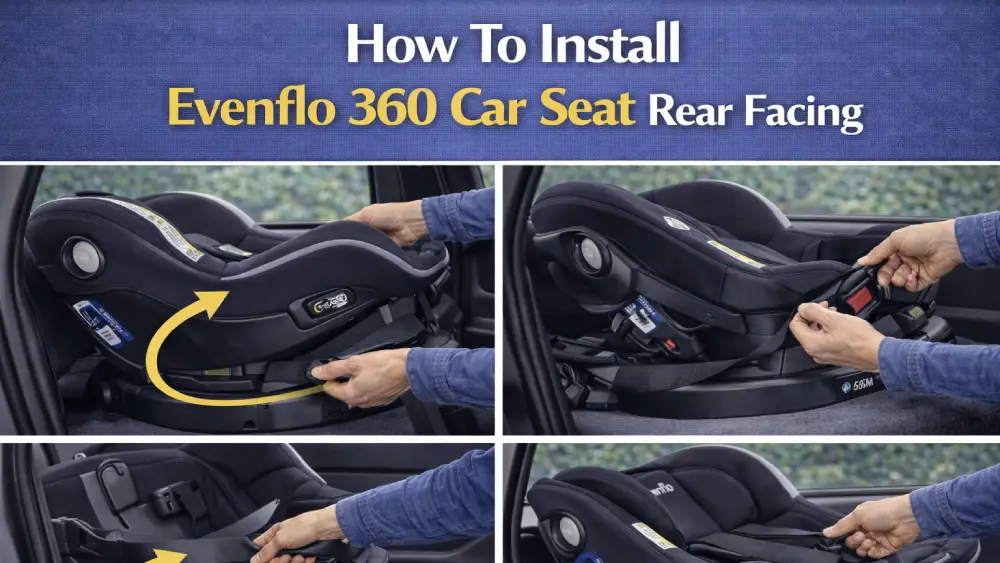
Rear-facing installation is one of the most important safety steps you’ll take for your child. The Evenflo 360 car seat makes daily use easier with its rotating design, but correct rear-facing installation is what ensures real protection. Learning how to install Evenflo 360 car seat rear facing helps you get the recline right, secure the base properly, and lock the seat safely before every drive.
Rear-facing isn’t just a starting phase—it’s the safest way for infants and toddlers to ride. This guide walks you through the entire rear-facing installation process step by step so you can install with confidence.
Let’s begin.
Why Rear-Facing Matters
Rear-facing seats are designed to support a child’s head, neck, and spine during a crash. Evenflo 360 seats are built to support extended rear-facing, which is widely recommended by safety experts.
Rear-facing should be used:
- From birth
- Until your child reaches the maximum rear-facing height or weight listed by Evenflo
Never rush the transition to forward-facing.
Before Installing the Evenflo 360 Rear Facing
Preparation prevents mistakes.
Before you start:
- Read the Evenflo manual and your vehicle owner’s manual
- Park on level ground
- Choose a rear seating position
- Decide whether to use LATCH or a seat belt
- Confirm your child meets rear-facing requirements
Never use LATCH and a seat belt together unless the manual explicitly allows it.
How To Install Evenflo 360 Car Seat Rear Facing (Step by Step)
Step 1: Position the seat
Place the Evenflo 360 on the back seat facing the rear of the vehicle. Make sure the base sits flat and centered on the seat cushion.
Step 2: Set the recline
Use the recline handle at the base of the seat. Adjust until the recline indicator shows the approved rear-facing range. This step is critical for proper head and airway positioning.
Step 3: Install using LATCH
If using LATCH:
- Extend both lower anchor connectors
- Attach them to the vehicle’s lower anchors
- Press down firmly on the seat
- Pull the LATCH adjustment strap until the seat moves less than one inch at the belt path
Step 4: Install using a seat belt
If using a seat belt:
- Route the belt through the rear-facing belt path
- Buckle the belt
- Lock the seat belt according to your vehicle’s instructions
- Apply pressure to the seat while pulling the belt tight
Use only one installation method.
Step 5: Check for movement
Grip the seat at the belt path and test side-to-side and front-to-back movement. The seat should move less than one inch.
Step 6: Lock the rotation
Rotate the seat until it clicks securely into the rear-facing travel position. Confirm the seat does not rotate freely.
Adjusting the Harness After Installation
Once the seat is installed:
- Harness straps should be at or below the shoulders
- Chest clip should sit at armpit level
- Harness should pass the pinch test
Always adjust the harness after installation, not before.
Common Rear-Facing Installation Mistakes to Avoid
These issues happen often:
- Ignoring the recline indicator
- Forgetting to lock the rotation
- Testing movement at the headrest instead of the belt path
- Using bulky clothing under the harness
- Switching to forward-facing too early
Double-checking prevents these errors.
How To Know the Rear-Facing Installation Is Correct
Before every drive:
- Recline indicator is within range
- Seat moves less than one inch
- Rotation is locked
- Harness fits snugly
- Chest clip is positioned correctly
If anything feels off, reinstall before driving.
Final Thoughts
Learning how to install Evenflo 360 car seat rear facing correctly ensures your child gets the highest level of protection during the most vulnerable stages. When the seat is level, tight, and locked, the rotating feature becomes a convenience—not a concern.
Take your time. Follow each step carefully. Lock the seat before every drive. Those habits make every ride safer.
If you’d like, I can automatically add:
Frequently Asked Questions
Yes, children should ride rear-facing until they reach the maximum height or weight limits listed by Evenflo.
Yes, you can use either LATCH or a seat belt, but never both at the same time.
Use the built-in recline indicator on the base to confirm it’s within the approved rear-facing range.
The seat should move less than one inch side-to-side or front-to-back at the belt path.
No, the top tether is only required for forward-facing installations.
Harness straps should be positioned at or below your child’s shoulders.
Yes, rotation can be used for loading, but the seat must be locked before driving.
Yes, if your vehicle allows proper installation in the center seating position.
Recline should be adjusted before final tightening and rechecked afterward.
Recheck after adjustments, cleaning, moving the seat, or periodically for safety.