
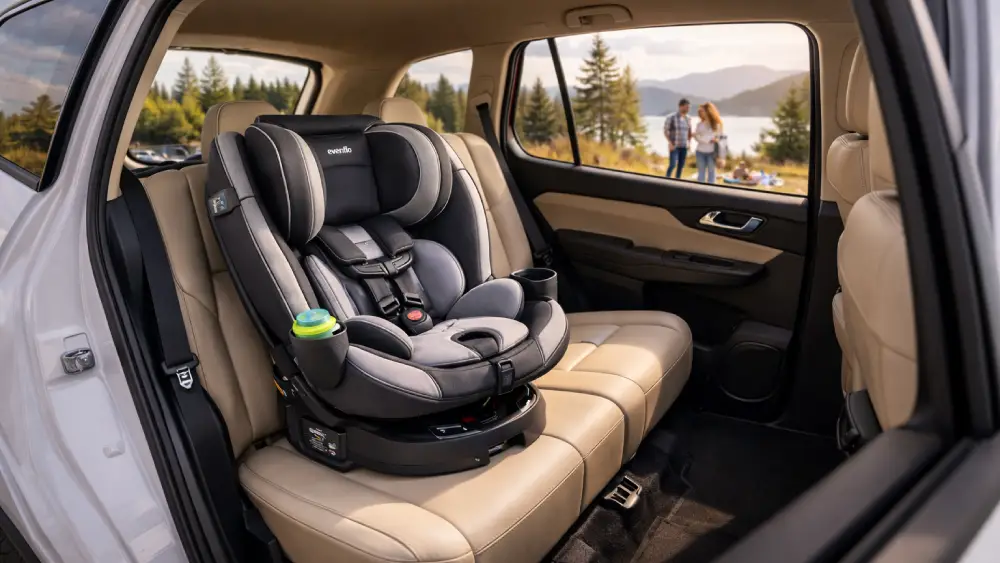
If you’re asking how safe is the Evenflo 360 car seat, you’re already doing something right. You’re not just shopping for convenience. You’re checking the one thing that matters most: whether this seat protects your child the way you expect it to.
And yes—rotating seats like the Evenflo 360 are very appealing. They look modern. They solve the daily struggle of twisting your back into a weird angle while buckling a toddler who suddenly hates being buckled.
But here’s the thing.
A car seat can be convenient and still be safe. It can also be safe and still be misused. The difference comes down to what the seat is built to do, what safety standards it meets, and—most importantly—how it’s installed and used in real life.
So in this guide, I’m going to answer the big question: how safe is the Evenflo 360 car seat, really?
We’ll cover safety standards, safety features, rear-facing vs forward-facing, installation quality, harness fit, and what to watch for as your child grows. I’ll also give you practical tips that make the seat safer in your actual vehicle, not just in theory.
Let’s dig in.
What Safety Standards All Car Seats Must Meet (And Why That Matters)
Before we even talk about the Evenflo 360, it helps to understand the baseline.
In the U.S., car seats sold legally must meet federal safety standards. That means the Evenflo 360 is not “unregulated.” It has to pass required crash testing.
This is a big deal, and it’s reassuring.
But it’s also important to understand what that does—and doesn’t—mean.
What Federal Standards Generally Cover
Car seats must meet testing requirements that evaluate:
- Crash performance (especially frontal impacts)
- Harness strength and restraint performance
- Structural integrity
- Labeling and instruction requirements
What Federal Standards Don’t Guarantee
Federal standards don’t guarantee:
- Your seat is installed correctly
- Your harness is adjusted correctly
- Your child is in the safest mode for their age
- Your vehicle’s seat geometry works well with the seat
So if you’re wondering how safe is the Evenflo 360 car seat, the first answer is:
It meets the required safety standards to be sold.
The second answer is the one that matters more:
Your safety outcome depends heavily on correct setup and daily use.
What the Evenflo 360 Actually Is (And Why It’s Popular)
The Evenflo 360—often sold under the Revolve360 name—is a rotating convertible car seat.
That means it’s designed to be used in multiple stages:
- Rear-facing for infants and toddlers
- Forward-facing for older toddlers and young children
The signature feature is the 360-degree rotation, which lets you swivel the seat toward the door for easier loading and harnessing.
Parents love this feature for a simple reason:
It reduces strain and makes daily buckling easier.
And easier buckling can mean better safety—because the more comfortable you are using a seat, the more likely you are to use it correctly.
That’s not marketing. That’s real life.
Safety Features Built Into the Evenflo 360 Car Seat
Now we’re getting into the part most people actually care about.
When parents ask how safe is the Evenflo 360 car seat, they’re usually asking:
- Does it protect well in a crash?
- Does the rotating base weaken anything?
- Does it have the safety features I want?
Let’s break it down.
1) Side Impact Protection
The Evenflo 360 is designed with side-impact protection features such as:
- Deep side walls
- A supportive headrest area
- Energy-absorbing materials (depending on model)
Side impacts are a major concern for parents, and this is one of the areas where modern convertible seats tend to focus their design.
2) Five-Point Harness System
A five-point harness is standard in convertible seats, but what matters is how well it fits.
The Evenflo 360 typically offers:
- Adjustable harness height
- A headrest that moves with harness positioning
- Padding and structure designed to keep the harness in place
A well-fitted harness is one of the biggest safety factors you can control.
3) Multiple Recline Positions
Recline affects:
- Rear-facing airway position
- Crash alignment
- Installation stability
Evenflo includes recline options and indicators to guide you.
4) Rotating Mechanism (Yes, It’s a Safety Feature Too)
Rotation is not a crash safety feature by itself. But it can improve safety indirectly.
Here’s how:
- Easier buckling = fewer daily shortcuts
- Easier harness tightening = fewer loose harness situations
- Easier loading = less chance you’ll “just skip the chest clip for this quick ride”
If you’ve ever been tempted to take a shortcut because you’re tired, you already understand why this matters.
Does the Rotating Feature Make It Less Safe?
This is the question hiding under the question.
And it’s fair.
When something rotates, people assume it’s less stable than a fixed seat. It feels like a moving part. And moving parts make parents nervous.
Here’s the practical answer:
The seat rotates for loading, but locks for travel.
In normal use, the seat should be locked in position when the vehicle is moving.
If installed correctly and locked correctly, rotation should not compromise safety.
But—and this is important—rotation adds complexity. And complexity increases the chance of misuse.
So if you’re asking how safe is the Evenflo 360 car seat, one honest answer is:
It can be very safe, but it’s not a “set it and forget it” seat.
You need to confirm it’s locked correctly every time.
Crash Testing and Independent Evaluations (What You Can Actually Rely On)
Let’s keep this simple and grounded.
Many parents go searching for crash test “scores” online. They want a ranking.
The problem is that crash test results aren’t always published in a clean, standardized way for every seat. And many “rankings” online are opinions dressed up as data.
So what can you reasonably rely on?
What You Can Trust
- The seat meets required federal safety standards
- The seat is designed for rear-facing and forward-facing use within its limits
- The manufacturer provides installation instructions and safety guidelines
- The seat includes indicators and features designed to reduce misuse
What You Should Treat Carefully
- Random blog claims about “best crash test results”
- Unverified “top 10 safest seats” lists
- Forums claiming a seat “failed testing” without evidence
If you want the most reliable safety boost, it’s not in a secret crash score.
It’s in installation and harness fit.
That’s where the real safety gains live.
Rear-Facing vs Forward-Facing: The Biggest Safety Decision You’ll Make
If you want to dramatically improve safety, this is where you focus.
Rear-facing is widely recommended for as long as your child fits within the seat’s rear-facing limits.
Why?
Because rear-facing better supports the head, neck, and spine in a crash.
Rear-Facing Safety: What to Prioritize
- Correct recline angle
- Proper harness fit
- Secure installation
- Rotation locked for travel
Forward-Facing Safety: What Changes
When you move forward-facing:
- The child’s body moves differently in a crash
- Harness fit becomes even more critical
- Top tether use may be required or strongly recommended
So if you’re asking how safe is the Evenflo 360 car seat, a big part of the answer is:
It’s safest when used rear-facing as long as your child fits.
Installation Safety: The Most Critical Factor (Yes, More Than the Seat Itself)
Here’s the blunt truth:
A perfectly engineered seat installed incorrectly is not safe.
A solid seat installed correctly is.
This is why installation matters so much.
The Two Installation Methods
Most Evenflo 360 models can be installed using:
- LATCH (lower anchors)
- Seat belt installation
Both can be safe. Both can be correct.
What “Correct” Installation Feels Like
- Base does not move more than about an inch at the belt path
- Recline indicator is in the correct zone
- Seat is locked into the correct travel position
- No twisting in straps or belt routing
Common Mistakes With Rotating Seats
This is where rotating seats can trip people up.
- The seat is installed tightly but not locked properly
- The base is secure but the seat isn’t fully clicked into place
- The recline is incorrect for rear-facing
- The seat rotates freely because it wasn’t locked into travel position
If you want to maximize safety, your goal is not “tight.”
Your goal is correct.
Quick Table: What Matters Most for Safety
Here’s a simple table that shows where your effort has the highest payoff.
| Safety Factor | How Much It Matters | What You Should Do |
| Rear-facing as long as possible | Very high | Stay rear-facing until you reach limits |
| Correct installation | Extremely high | Check movement at belt path |
| Correct recline | High | Use recline indicator every time |
| Correct harness fit | Extremely high | Snug harness, correct shoulder height |
| Rotation locked for travel | High | Confirm lock before driving |
| Extra padding/accessories | Low (sometimes risky) | Use only manufacturer-approved items |
If you do the top four well, you’re already making the seat significantly safer.
Harness Fit and Child Positioning (Where Many People Lose Safety Points)
Even parents who install perfectly sometimes miss harness fit.
And I don’t blame them. Harness adjustments are easy to do “almost right,” which is where mistakes hide.
What Correct Harness Fit Looks Like
- Harness is snug (no slack you can pinch at the shoulder)
- Chest clip is at armpit level
- Straps lie flat (not twisted)
- Harness height is correct for rear-facing vs forward-facing
Rear-Facing Harness Height
Generally:
- Straps should come from at or below the shoulders
Forward-Facing Harness Height
Generally:
- Straps should come from at or above the shoulders
(Always confirm with your seat manual, because models vary.)
If you want a real-world answer to how safe is the Evenflo 360 car seat, harness fit is one of the strongest safety levers you control daily.
Real-World Safety: What Parents Actually Experience
Now let’s talk about reality.
Because real-world safety isn’t just crash performance. It’s how consistently the seat gets used correctly.
Parents often report these real-world advantages of rotating seats like the Evenflo 360:
- Easier buckling in tight parking spots
- Less back strain (especially postpartum)
- Better ability to tighten the harness correctly
- Less wrestling with a twisting toddler
That’s not a small thing.
A seat you can use correctly every single day is a safer seat in practice.
But there are real-world downsides too:
- The seat can be heavier and bulkier
- Some vehicles have tighter fits
- Rotation locks can confuse first-time users
So again, when you ask how safe is the Evenflo 360 car seat, the honest answer is:
It’s safe when used correctly—and it’s designed in a way that can make correct use easier.
How the Evenflo 360 Compares to Other Rotating Car Seats
I’m not going to turn this into a brand battle.
But it helps to know what you’re comparing.
Here’s a clean, factual comparison of what rotating seats typically differ on.
| Feature | Evenflo 360 | Other 360 Seats (General) |
| Rotation convenience | Strong | Varies |
| Ease of buckling | High | Varies |
| Installation complexity | Moderate | Moderate |
| Size/bulk | Moderate to high | Varies |
| Indicators and locks | Yes | Usually yes |
The takeaway isn’t “best” or “worst.”
The takeaway is that rotating seats often share the same tradeoff:
more convenience, slightly more complexity.
Recalls, Safety Notices, and Manufacturer Support
When people ask how safe is the Evenflo 360 car seat, they often mean:
“Has this seat had recalls?”
It’s a smart question.
The best practice is always:
- Register your seat with the manufacturer
- Check official recall sources periodically
- Keep your model info and manufacture date accessible
I won’t pretend any brand is immune from recalls. They happen across the industry.
What matters is:
- Whether the manufacturer communicates clearly
- Whether fixes are offered promptly
- Whether you can identify if your seat is affected
Registering your seat is one of the simplest safety steps you can take.
Expert-Level Tips for Maximizing Safety With the Evenflo 360
This is the section that gives you real leverage.
If you want to make the Evenflo 360 as safe as possible, here’s what I recommend.
1) Check the Lock Every Single Drive
Before you pull out:
- Confirm the seat is locked into the travel position
- Confirm it’s not halfway rotated
This takes two seconds and prevents a lot of misuse.
2) Recheck Recline After Tightening
Tightening the install can shift the recline slightly.
So:
- Set recline
- Tighten install
- Recheck recline
3) Don’t Add Unapproved Accessories
No third-party inserts. No strap covers that didn’t come with the seat.
They can interfere with harness fit.
4) Use Rear-Facing as Long as Possible
This is still one of the biggest safety upgrades you can make.
5) Recheck Harness Fit Every Few Weeks
Kids grow fast. Harness fit changes faster than you think.
Final Verdict: So, How Safe Is the Evenflo 360 Car Seat?
Let’s land this clearly.
If you’re asking how safe is the Evenflo 360 car seat, the most accurate answer is:
It’s a safe, regulation-compliant convertible seat with modern safety features, and its rotation can reduce daily misuse—if you install and use it correctly.
That’s not a vague answer. It’s the real one.
The Evenflo 360 is not magically safer because it rotates. But it can be safer in real life because it makes correct harnessing easier, and it reduces the daily friction that causes parents to cut corners.
And if you take installation seriously, keep your child rear-facing as long as possible, and maintain proper harness fit?
You’re doing exactly what safety experts want you to do.
So yes—if you’ve been wondering how safe is the Evenflo 360 car seat, you can feel confident using it.
Just don’t treat it like a gadget.
Treat it like safety equipment. Because it is.
And you’re already on the right track.
Frequently Asked Questions
It meets the same federal safety standards, with rotation designed for easier, more consistent daily use.
No, the seat locks into position for travel and is designed to remain stable when installed correctly.
Yes, as long as your newborn meets the minimum size requirements and the seat is reclined and harnessed properly.
Yes, rear-facing offers better head, neck, and spine protection and should be used as long as your child fits the limits.
Absolutely—improper installation is one of the biggest factors that can compromise safety.
Yes, easier access can lead to better harness tightening and fewer daily shortcuts.
Both methods are safe if installed correctly; use the one that gives you the most secure fit.
Check that the seat clicks into the travel position and does not rotate freely while driving.
No, only use accessories approved by Evenflo, as unapproved items can interfere with harness safety.
Recheck installation, recline, and harness fit regularly, especially after growth spurts or long trips.