
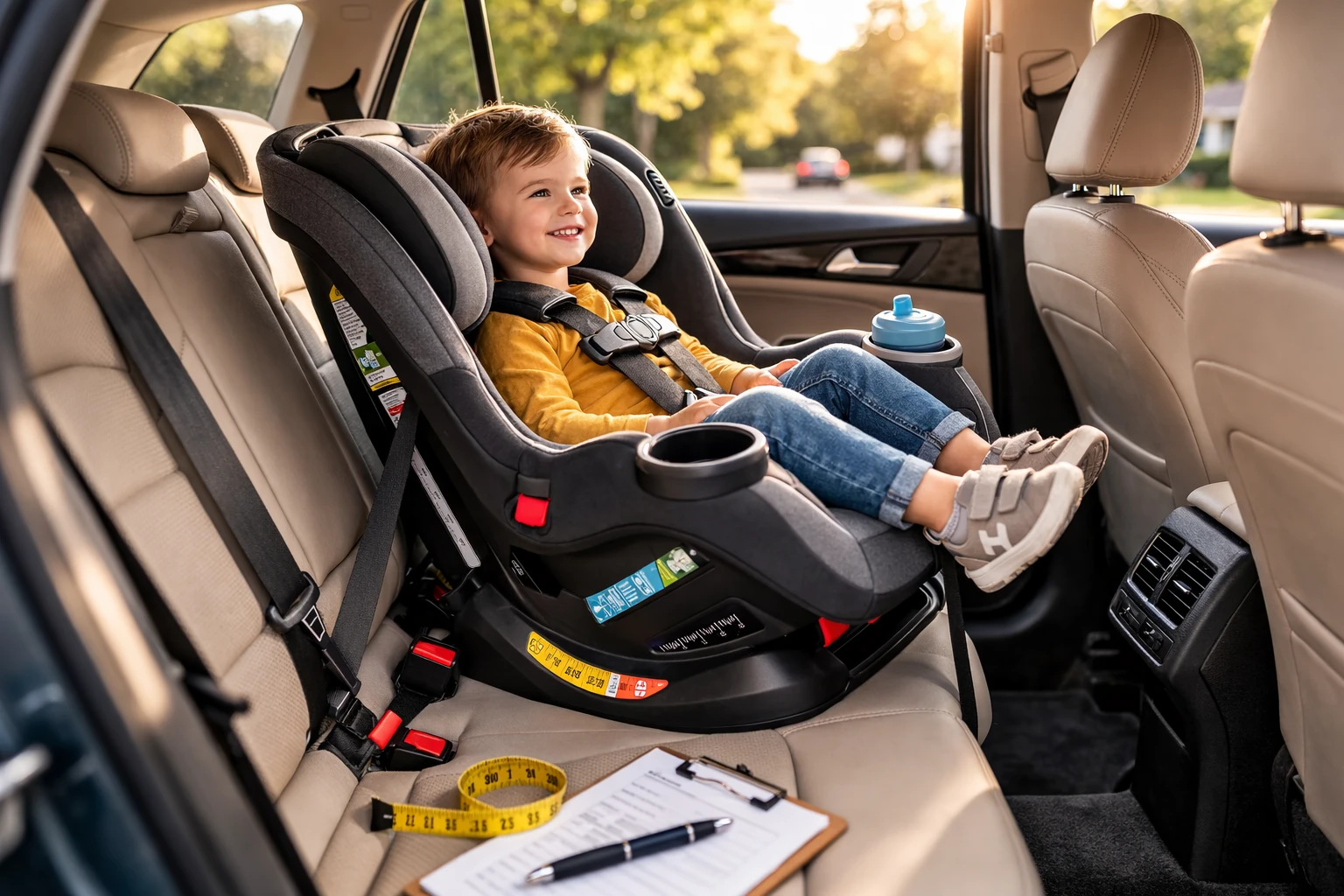
Extended rear-facing car seat weight limits are not just numbers printed on a label. They represent physics. They represent protection. And in a crash, they can represent the difference between manageable forces and catastrophic injury.
I’ve spoken with many parents who assume once their child turns two, it’s time to flip the seat forward. It feels like a milestone. It looks more comfortable. It seems convenient. But when you understand how extended rear-facing car seat weight limits work and why they exist you start making decisions based on science instead of tradition. Let’s break this down clearly. No fluff. No fear tactics. Just practical, actionable guidance you can use immediately.
What Does “Extended Rear-Facing” Actually Mean?
Rear-facing means the car seat is positioned so the child faces the back of the vehicle. In a crash, the seat absorbs and distributes the force across the child’s back.
“Extended” rear-facing simply means keeping your child rear-facing beyond the bare minimum required by law.
Most state laws require rear-facing until age 2. But legal minimums are not safety maximums. Extended rear-facing car seat weight limits typically allow children to remain rear-facing until 40, 45, or even 50 pounds—often well past age 3 or 4.
Here’s the key distinction:
- Legal minimum = the earliest you can turn them forward.
- Best practice = the safest time to turn them forward.
- Manufacturer maximum = the upper limit defined by extended rear-facing car seat weight limits.
Those are not the same thing.
Why Rear-Facing Is Safer (And Why Weight Limits Matter)
Let’s talk physics.
In a frontal crash which is the most common severe crash type the vehicle stops suddenly. Everything inside keeps moving. Including your child. If they’re forward-facing, their body is restrained by the harness, but their head continues forward. Toddlers have proportionally large heads and developing neck structures. That forward force strains the spine.
Rear-facing changes the equation entirely.
Instead of the harness stopping the child’s body while the head moves forward, the entire shell of the seat cradles the head, neck, and spine together. The crash forces are distributed across the strongest parts of the body.
This principle is grounded in crash force distribution and the science of biomechanics, which studies how forces interact with the human body. When you understand biomechanics, extended rear-facing car seat weight limits start to make perfect sense. The weight limit isn’t arbitrary. It reflects the structural capacity of the seat to protect a child rear-facing under crash testing standards.
Understanding Extended Rear-Facing Car Seat Weight Limits
Most modern convertible and all-in-one seats allow rear-facing between:
- 4–40 pounds
- 5–45 pounds
- Some up to 50 pounds
Here’s a simplified comparison:
| Seat Type | Typical Rear-Facing Weight Limit | Typical Age Range |
| Infant Seat | 22–35 lbs | Birth–12 months |
| Convertible Seat | 40–50 lbs | Birth–4+ years |
| All-in-One Seat | 40–50 lbs | Birth–5+ years |
Extended rear-facing car seat weight limits are usually found in convertible or all-in-one seats not infant carriers.
But here’s where parents get confused: weight is only one factor.
You must also consider height.
Weight Limits vs Height Limits: Both Can End Rear-Facing
Many children outgrow rear-facing by height before they hit the maximum weight.
Manufacturers define rear-facing height limits in two common ways:
- Standing height maximum (e.g., 40 inches)
- Head position rule (head must be at least 1 inch below top of shell)
That second rule matters.
If your child’s head is too close to the top of the seat shell, the seat can’t properly contain the head during a crash even if they’re under the weight limit.
Here’s what I recommend:
- Check the manual. Always.
- Sit your child in the seat without shoes.
- Ensure harness straps are at or below shoulder level.
- Confirm at least 1 inch of hard shell remains above the head.
Extended rear-facing car seat weight limits only work when height limits are also respected.
Convertible vs All-in-One Seats: Which Supports Extended Rear-Facing Better?
Both can support extended rear-facing. The difference comes down to longevity and features.
Convertible Seats
- Rear-facing and forward-facing only
- Often lighter
- Sometimes higher rear-facing weight limits
- Great mid-term option
All-in-One Seats
- Rear-facing, forward-facing, booster mode
- Higher initial cost
- Longest lifespan
- May offer extended rear-facing car seat weight limits up to 50 lbs
If your goal is maximizing rear-facing duration, look for:
- Rear-facing weight limit of at least 45 lbs
- Tall seat shell
- Adjustable headrest
- Steel-reinforced frame
- Anti-rebound bar or load leg
Extended rear-facing car seat weight limits vary widely by brand and model. Always compare specifications not marketing claims.
Installation Matters More Than You Think
A seat with excellent extended rear-facing car seat weight limits is useless if installed incorrectly.
Pay attention to:
- Correct recline angle (use built-in level indicators)
- Tight installation (less than 1 inch of movement at belt path)
- Harness snugness (no slack at shoulders)
- Chest clip at armpit level
Use either LATCH or seat belt never both unless the manual allows it.
As your child eventually transitions out of extended rear-facing car seat weight limits and into forward-facing mode, proper installation becomes just as critical. Many parents search for guidance on How to Install a Forward Facing Graco Car Seat, but the same foundational principles apply across brands: use either LATCH or the vehicle seat belt (not both unless allowed), ensure less than one inch of movement at the belt path, and always attach the top tether when forward-facing. The tether significantly reduces forward head movement in a crash and should never be skipped. Also remember: LATCH systems have combined weight limits (child + seat). As your child approaches higher weights allowed under extended rear-facing car seat weight limits, you may need to switch to seat belt installation.
Details matter here.
When Should You Stop Rear-Facing?
Simple answer:
- When your child reaches the maximum rear-facing weight limit
- Or exceeds the rear-facing height limit
- Or the seat manual specifically states transition is required
Not when they turn two.
Not when grandparents suggest it.
Not when their feet touch the back seat.
Extended rear-facing car seat weight limits exist for a reason. Use them fully.
For official guidance on child passenger safety recommendations, you can review resources from the National Highway Traffic Safety Administration (NHTSA). Government safety agencies consistently recommend keeping children rear-facing as long as possible within the limits of their car seat.
That phrase matters: within manufacturer limits.
Signs You May Need to Upgrade Your Seat
- Child within 2–3 pounds of rear-facing max
- Head within 1 inch of shell top
- Harness straps no longer properly positioned
- Seat nearing expiration date
- Recall issued by manufacturer
Car seats typically expire after 6–10 years. Materials degrade. Safety standards evolve. Don’t push beyond limits.
The Bigger Picture: Why Extended Rear-Facing Is Worth It
Parenting is full of visible milestones.
First steps.
First words.
First forward-facing ride.
But not all milestones are progress. Turning a child forward-facing early doesn’t improve safety. It reduces it. Extended rear-facing car seat weight limits are engineered with crash testing data. They reflect real-world injury patterns. They are not marketing gimmicks. When I evaluate safety decisions, I ask one question: Does this increase protection or reduce it? Rear-facing longer increases it. Period.
Action Plan: What You Should Do Next
If you’re unsure where you stand, take these steps today:
- Check your current seat’s manual.
- Confirm rear-facing maximum weight.
- Measure your child’s weight and height.
- Inspect shell clearance.
- Verify installation tightness.
- Schedule a check with a certified child passenger safety technician if needed.
Knowledge beats guesswork.
Final Thoughts: Safety Over Milestones
Extended rear-facing car seat weight limits are not about overprotectiveness. They are about respecting physics. Your child’s spine is still developing at age two. At three. Even at four. The safest position in a frontal crash remains rear-facing. The longer you can responsibly maintain that position within the seat’s limits, the better. Use the full capability of your car seat. That’s what those extended rear-facing car seat weight limits were designed for. Because when it comes to safety, we don’t rush milestones.
FAQs
They are the maximum weight a child can reach while remaining rear-facing, as specified by the car seat manufacturer.
Children should remain rear-facing until they reach the highest rear-facing weight or height limit allowed by their seat.
Yes. Rear-facing continues to provide superior head, neck, and spine protection well beyond age two.
You must transition to forward-facing once the maximum rear-facing weight or height limit is exceeded.
Not necessarily; many seats have tall shells designed to accommodate extended rear-facing safely.
Leg injuries are uncommon in rear-facing crashes, and the risk of serious neck injury is significantly lower.
It depends on the seat and vehicle; some require switching to seat belt installation at higher combined weights.
Check the manual for a rear-facing maximum weight of 40–50 pounds and review the height limits.
Yes. Laws set minimums, but you can legally keep your child rear-facing longer within manufacturer limits.
Do extended rear-facing car seat weight limits vary by brand?