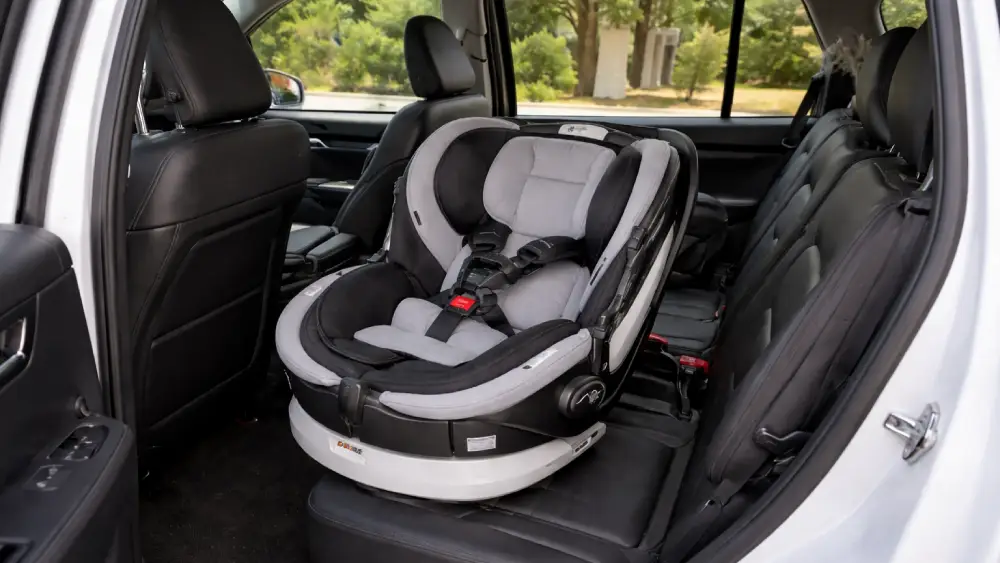
Parents don’t search for Evenflo Revolve 360 rear-facing limits out of curiosity. They search because they want certainty. They want to know: Is my child still safe? Are we close to the limit? Am I missing something? I get it. The numbers printed on the label look simple. The real-world application? Not always.
In this guide, we’ll break down the Evenflo Revolve 360 rear-facing limits in practical terms—weight, height, and the often-overlooked “fit” rule. You’ll also learn how to check whether your child truly still fits rear-facing, what installation details can quietly affect safety, and when it’s genuinely time to switch forward-facing. Clear. Direct. No fluff.
Quick Answer: Rear-Facing Limits at a Glance
Before we go deeper, here’s the simplified snapshot. Always verify your specific model’s label and manual, but most Evenflo Revolve 360 models fall within these rear-facing parameters:
| Limit Type | Typical Range (Model Dependent) |
| Rear-Facing Weight | Approximately 4–40 lbs |
| Rear-Facing Height | Up to 40 inches (varies by model) |
| Fit Requirement | Child’s head must remain below required headrest clearance; harness must be at/below shoulders |
That last row matters more than many parents realize.
Even if your child is under the listed weight and height, they must still meet the head clearance and harness positioning rules. The Evenflo Revolve 360 rear-facing limits are not just about hitting a number. They are about how your child physically fits in the shell of the seat.
And yes, limits can vary between versions like Revolve360, Revolve360 Gold, and Revolve360 Extend. Always confirm your exact model.
Which Evenflo Revolve 360 Model Do You Have?
This matters. A lot.
Evenflo has released multiple versions under the Revolve 360 name. While they look similar and share the rotating base feature, their rear-facing limits can differ slightly in weight ranges or design features.
Here’s how to confirm:
- Look for the white label on the side or bottom of the seat shell.
- Identify the exact model name and manufacture date.
- Cross-check the manual for that specific model (not a “similar” one).
- Verify rear-facing weight AND height limits printed directly on the seat.
If you’re researching Evenflo Revolve 360 rear-facing limits, do not assume all models are identical. They’re not.
Five minutes checking the label can prevent months of confusion.
Rear-Facing Limits Explained (The Part Most People Miss)
The limits are straightforward. The application isn’t.
Let’s break this down properly.
1. The Weight Limit
Rear-facing weight limits define the maximum child weight the seat is tested to support in a rear-facing crash scenario.
If your child exceeds that number—even by one pound—the seat must be used forward-facing. No rounding down. No guessing.
Crash forces increase with weight. The seat’s structure and rotation mechanism are engineered within specific thresholds. That’s why the listed number is not a suggestion. It’s a hard stop.
Action step: Weigh your child fully dressed, but without shoes, on a reliable scale. Do this every few months once they pass 30 pounds.
2. The Height Limit
Height limits can be misunderstood.
Some parents assume if their child is under 40 inches, they’re fine. Not necessarily.
Height limits serve as a general boundary. But seated height and torso length affect fit more than standing height. Two children can both be 38 inches tall and fit very differently in the same seat.
This is where the Evenflo Revolve 360 rear-facing limits become more than numbers.z
3. The Fit Rule (This Is Critical)
The seat shell must extend above your child’s head by the required amount stated in the manual. If the head rises above the permitted headrest clearance, rear-facing use must stop—even if weight and standing height are within range.
Additionally:
- Harness straps must be at or slightly below the shoulders when rear-facing.
- Harness must pass the pinch test (no slack at collarbone).
- Headrest must be adjusted appropriately as your child grows.
Fit ends rear-facing more often than weight does.
This is the most overlooked aspect of Evenflo Revolve 360 rear-facing limits.
How to Tell if Your Child Still Fits Rear-Facing
Let’s make this practical.
Here’s your step-by-step check:
Step 1: Confirm Weight
Weigh your child. Don’t estimate. Write it down.
Step 2: Check Standing Height
Measure against a wall. Shoes off.
Step 3: Inspect Head Clearance
With your child buckled:
- Look at where the top of the head sits relative to the headrest.
- Confirm required clearance per your manual.
If the top of the ears approach the shell limit, it’s time to double-check everything carefully.
Step 4: Check Harness Position
For rear-facing:
- Shoulder straps must be at or below the shoulders.
- Pull harness snug. Perform the pinch test.
No slack. None.
Step 5: Re-check After Rotating
This is important.
Because the Revolve 360 rotates, parents sometimes introduce slack when turning the seat back to rear-facing position. Always re-check harness snugness after rotating.
Small detail. Big impact.
Installation Factors That Quietly Affect Rear-Facing Use
Even if your child fits within the Evenflo Revolve 360 rear-facing limits, installation errors can compromise protection.
Here’s what to verify:
Recline Angle
Rear-facing seats must be within the allowed recline indicator zone. Too upright can affect head clearance and crash dynamics. Too reclined can cause improper positioning.
If your vehicle seat slopes heavily, you may need to adjust positioning carefully within allowed limits.
Movement Test
At the belt path:
- Grab the seat.
- Attempt to move side-to-side and front-to-back.
It should not move more than 1 inch.
LATCH vs Seat Belt
Use one method unless your manual explicitly allows both. Check the LATCH weight limit in your vehicle and car seat manual combined.
Rotation Reality Check
The rotation feature makes daily use easier. It does not eliminate the need for installation tightness checks.
Convenience is not a substitute for security.
Common Misunderstandings About Evenflo Revolve 360 Rear-Facing Limits
Let’s clear up some recurring issues.
“My child’s legs are bent. It must be unsafe.”
It’s not.
Children are flexible. Crossed legs, bent knees, feet on the seatback—these are normal and safe rear-facing positions.
“They look cramped.”
Appearance does not equal safety risk. Head clearance and harness position matter. Not legroom.
“All Revolve 360 models have the same limits.”
They don’t. Confirm your version.
“We hit 35 pounds, so we should turn forward-facing.”
No. Rear-facing to the maximum limit is safest within the seat’s approved range.
The Evenflo Revolve 360 rear-facing limits are designed to keep children rear-facing as long as possible within structural testing parameters.
“Aftermarket inserts will make it fit longer.”
Do not use non-approved accessories. They can interfere with crash performance.
When It’s Time to Switch Forward-Facing
This moment should be clear. Not emotional.
Switch to forward-facing when:
- Your child exceeds the rear-facing weight limit.
- Your child exceeds the rear-facing height limit.
- Your child no longer meets the required head clearance.
- Harness can no longer be positioned at/below shoulders rear-facing.
Before switching:
- Re-adjust headrest.
- Confirm correct recline.
- Re-check weight and measurement.
Sometimes parents switch prematurely because of a simple adjustment oversight.
Take a breath. Double-check everything.
Then move forward confidently.
How to Safely Maximize Rear-Facing Time
Want to ensure you’re using the full range of the Evenflo Revolve 360 rear-facing limits? Here’s how.
- Dress your child in thin, non-bulky clothing.
- Tighten harness every ride. Every time.
- Reassess fit every 2–3 months after age 2.
- Keep the headrest properly adjusted as they grow.
- Monitor weight carefully once above 30 pounds.
Rear-facing offers superior head, neck, and spine protection in a crash. The Revolve 360 design supports extended rear-facing when used correctly.
Use the limits fully—but precisely.
Final Thoughts
The Evenflo Revolve 360 rear-facing limits are not just printed numbers. They are a system—weight, height, and physical fit working together to define safe use. When parents understand all three components, decisions become easier. More confident.
Measure carefully. Install correctly. Adjust often.
And when the time comes to switch forward-facing, you’ll know it’s because your child truly reached the limit—not because of guesswork.
That’s peace of mind.
Frequently Asked Questions
Most models allow rear-facing from about 4–40 pounds and up to 40 inches, but always confirm your specific seat label.
No, limits can vary slightly between Revolve360, Gold, and Extend versions, so check your manual carefully.
Both matter, but proper head clearance and harness positioning often determine fit before maximum weight is reached.
If they exceed the weight, height, or required head clearance listed in the manual, it’s time to transition.
Yes, bent or crossed legs are completely normal and do not affect safety.
Rear-facing harness straps must be at or slightly below your child’s shoulders.
No, the rotation adds convenience but does not change the Evenflo Revolve 360 rear-facing limits.
Check every few months and after noticeable growth spurts.
No, once the maximum rear-facing weight limit is reached, forward-facing use is required.
Yes, thick clothing can create harness slack, so use thin layers and tighten the straps snugly.