
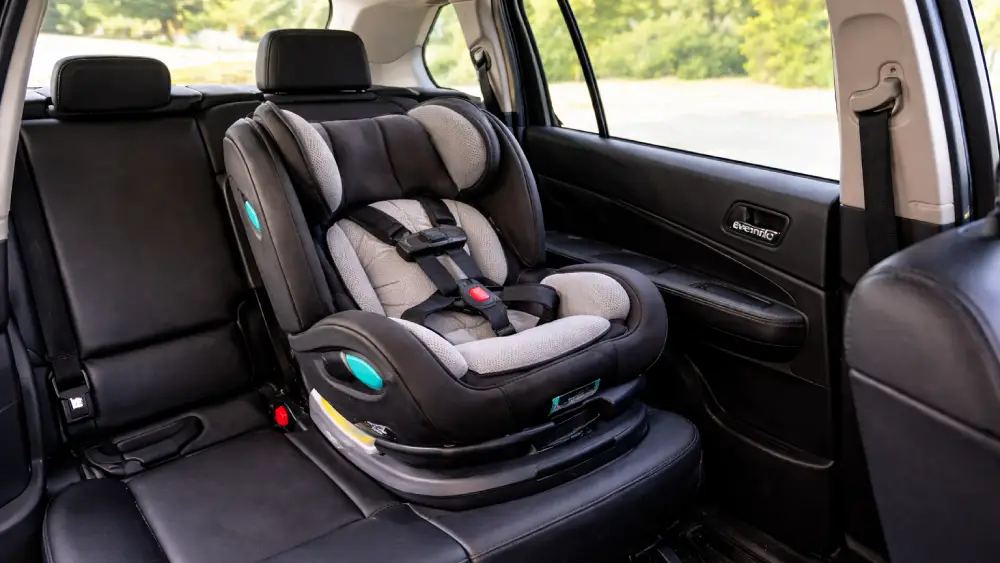
Understanding Evenflo 360 rear facing limits is one of the most important steps you can take to protect your child in the car. I’ve seen far too many parents rely on guesswork or general advice instead of checking the actual specifications of their seat. That’s risky. Rear-facing positioning dramatically reduces injury risk in a crash, but only when the seat is used within its designed limits.
The Evenflo 360 line has become popular because of its rotating feature and extended rear-facing capabilities. It’s convenient. It feels modern. And it makes daily loading and unloading easier on your back. But convenience never overrides safety. In this guide, I’ll break down the exact weight and height parameters, explain how long most kids can realistically stay rear-facing, and help you recognize when it’s truly time to transition.
Let’s get specific.
What Is the Evenflo 360 Car Seat?
The Evenflo Revolve360 is a rotating convertible car seat designed to swivel toward the door for easier access. Once secured, it locks into position for travel. That rotation feature is a game changer for many families.
Several models exist within the 360 lineup:
- Revolve360
- Revolve360 Slim
- Revolve360 Extend
Each has slightly different specifications, and those differences matter when discussing Evenflo 360 rear facing limits. The “Extend” model, for example, typically allows higher rear-facing weight capacity compared to the standard version.
Parents often choose this seat because it:
- Rotates 360 degrees for easier loading
- Converts from rear-facing to forward-facing
- Offers extended rear-facing capability
- Includes an integrated installation system
But features don’t determine safety outcomes. Proper use within limits does.
Evenflo 360 Rear Facing Weight Limits
Weight limits are non-negotiable. They’re determined by crash testing and structural design.
Most Evenflo 360 models allow rear-facing use from 4 pounds up to 40 pounds. The Extend version may go up to 50 pounds rear-facing, depending on the exact model.
Here’s a simplified comparison:
| Model | Rear-Facing Weight Range |
| Revolve360 | 4–40 lbs |
| Revolve360 Slim | 4–40 lbs |
| Revolve360 Extend | 4–50 lbs |
Always confirm with your specific manual. Small production differences can matter.
Why weight matters so much:
- The harness system is engineered for a defined load range.
- The shell absorbs crash forces within tested parameters.
- Exceeding weight limits changes crash dynamics significantly.
If your child exceeds the maximum rear-facing weight, the Evenflo 360 rear facing limits have been reached. No exceptions.
I strongly recommend checking your child’s weight every few months. Growth isn’t always predictable.
Evenflo 360 Rear Facing Height Limits
Height limits are just as critical, but often misunderstood.
Most Evenflo 360 models specify a rear-facing height range of approximately 17 inches to 40 inches, though exact measurements vary by model. However, total height alone isn’t the real determining factor.
What truly matters:
- The child’s head must be at least 1 inch below the top of the headrest or shell.
- The harness must sit at or below shoulder level when rear-facing.
- The headrest must be adjusted correctly as your child grows.
Torso height plays a bigger role than overall height. Two children can both be 38 inches tall, yet one may outgrow the seat sooner due to a longer torso.
If the top of your child’s head comes within one inch of the shell, you’ve reached the Evenflo 360 rear facing limits for height — even if they’re under the weight maximum.
That one-inch rule is not optional.
Age Recommendations vs. Rear Facing Limits
Here’s where confusion sets in.
Many state laws allow forward-facing at age two. That does not mean it’s safest at two.
The American Academy of Pediatrics recommends keeping children rear-facing as long as possible within the car seat’s limits. That means using the full capacity of the Evenflo 360 rear facing limits whenever feasible.
Rear-facing protects:
- The spine
- The neck
- The head
In a frontal collision, a rear-facing seat cradles the child’s entire body. Forward-facing shifts force to the harness and neck. That difference is significant.
If your child fits within the Evenflo 360 rear facing limits, there is rarely a safety reason to rush the transition.
Leg discomfort is not a valid reason. Children are flexible. Broken legs are rare in rear-facing crashes; spinal injuries are not.
How Long Can a Child Stay Rear Facing in the Evenflo 360?
This depends entirely on growth patterns.
On average:
- A 40 lb rear-facing limit may accommodate children until age 4.
- A 50 lb limit (Extend model) may allow rear-facing to age 5 or beyond.
Percentile matters. A child in the 90th percentile for weight may outgrow a 40 lb model much earlier. A child in the 25th percentile may use it much longer.
I recommend monitoring three milestones:
- Approaching 35 pounds (start watching closely).
- Crossing 38 pounds (plan ahead).
- Nearing height threshold (check shell clearance monthly).
The Evenflo 360 rear facing limits give you a safety window. Use it fully.
Signs Your Child Has Outgrown Rear Facing
You’ve reached the limit if:
- Your child exceeds the maximum rear-facing weight.
- The top of the head is within 1 inch of the shell.
- The harness can no longer be positioned correctly.
- The manual explicitly indicates the child no longer qualifies.
Do not guess.
If any of those occur, transition according to the manufacturer’s forward-facing instructions. But only after confirming the Evenflo 360 rear facing limits are actually exceeded.
Rear Facing vs. Forward Facing in the Evenflo 360
Rear-facing is statistically safer for young children. That’s clear.
Forward-facing becomes appropriate only once the Evenflo 360 rear facing limits are reached. Not before.
The rotating base makes switching modes easier, but ease should never dictate timing. I advise parents to emotionally separate convenience from safety decisions.
Switch when limits are met. Not when pressure mounts from relatives.
Installation and Recline Requirements
Proper installation directly affects safety performance.
Rear-facing requires:
- Correct recline angle (check the level indicator)
- Secure LATCH or seat belt installation
- Less than 1 inch of movement at the belt path
- Locked rotation before driving
Common mistakes I see:
- Incorrect recline position
- Loose installation
- Twisted harness straps
- Bulky coats under harness
Even the safest seat fails if installed incorrectly. If possible, schedule a check with a certified Child Passenger Safety Technician.
The Evenflo 360 rear facing limits only protect your child when installation is correct.
Common Parent Questions
Can my 3-year-old stay rear-facing?
If they fall within the Evenflo 360 rear facing limits for weight and height, absolutely.
Is 40 pounds the maximum rear-facing weight?
For standard models, typically yes. For Extend models, it may be 50 pounds.
What if my child’s legs bend or touch the seat?
That’s normal. Children are comfortable sitting cross-legged.
Can I rotate the seat while driving?
No. It must be locked in position.
Does extended rear-facing cause discomfort?
Not typically. Kids adapt easily.
Safety Tips to Maximize Protection
Small adjustments make a big difference.
- Perform the “pinch test” on the harness — no slack at the shoulder.
- Position the chest clip at armpit level.
- Remove bulky clothing before strapping in.
- Check fit monthly during growth spurts.
- Register your seat for recall notifications.
Consistency builds safety.
Comparing Evenflo 360 to Other Rotating Seats
The Evenflo 360 rear facing limits are competitive within the rotating seat market. Not all swivel seats offer extended rear-facing beyond 40 pounds.
If extended rear-facing is your top priority, the 50-pound capacity models stand out. That additional margin can translate to an extra year of rear-facing use.
Specs matter. Always compare:
- Rear-facing maximum weight
- Rear-facing maximum height
- Shell height
- Installation mechanism
Never assume similar designs mean identical limits.
Final Thoughts: When Should You Switch?
Switch from rear-facing only after exceeding the Evenflo 360 rear facing limits. That’s the standard I follow and recommend.
Weight over the limit? Switch.
Head within one inch of the top? Switch.
Harness no longer fits properly? Switch.
Otherwise, stay rear-facing.
The Evenflo 360 rear facing limits are designed to give parents flexibility while prioritizing safety. Use the full range. Monitor growth. Double-check installation. Stay informed.
Car seat decisions don’t have to feel overwhelming. When you understand the numbers and respect the limits, the path forward becomes clear.
And when it comes to protecting your child on the road, clarity is everything.
Frequently Asked Questions
Most models allow rear-facing from 4–40 pounds, while the Extend version may allow up to 50 pounds.
Rear-facing typically accommodates children up to about 40 inches tall, provided the head remains 1 inch below the shell.
Your child has outgrown it if they exceed the maximum weight, height, or no longer meet the 1-inch head clearance rule.
Yes, if they remain within the Evenflo 360 rear facing limits for weight and height.
Yes, bent legs are normal and not a safety concern in rear-facing seats.
Yes, certain Extend models increase the rear-facing weight limit to 50 pounds—always confirm in your manual.
While legal in some states, it’s safest to stay rear-facing until the Evenflo 360 rear facing limits are reached.
Check every few months and during growth spurts to ensure they still meet the rear-facing requirements.
No, as long as the seat is properly locked into position before driving.
Check the car seat manual and the labels on the seat for the most accurate Evenflo 360 rear facing limits.