
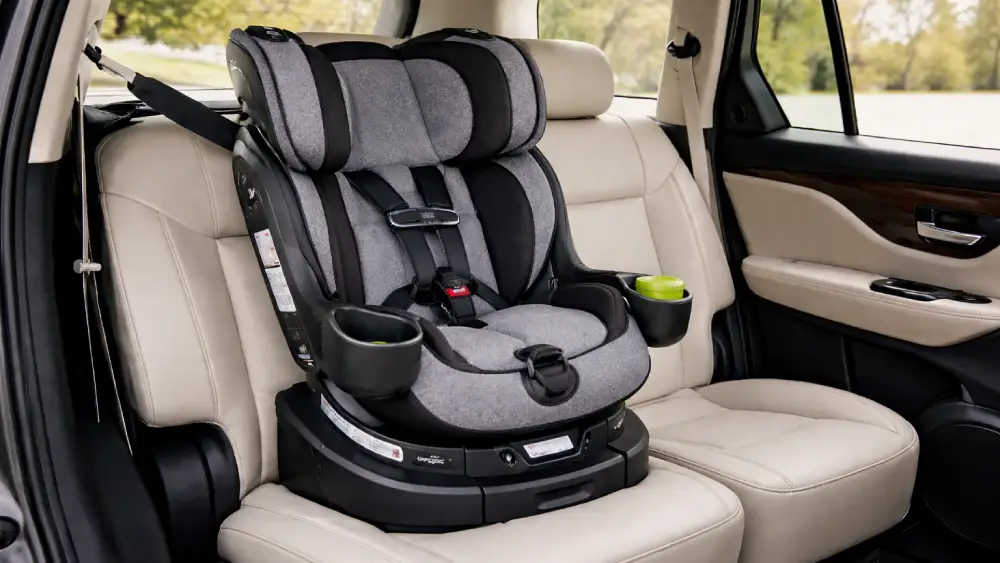
Parents love the spin. The safety matters more. And when it comes to Evenflo 360 front facing requirements, getting the details right is not optional — it’s critical.
The Evenflo Revolve360 is one of the most popular rotating car seats on the market. It turns toward you. It feels intuitive. But the transition from rear-facing to forward-facing is a serious milestone, and it must be done correctly. Not when it’s convenient. Not when your toddler’s legs look “long.” When they actually meet the requirements.
Let’s break this down clearly, practically, and without fluff.
What Is the Evenflo 360 Car Seat?
The Evenflo Revolve360 line includes several models: Revolve360, Revolve360 Slim, Revolve360 Extend, and Revolve360 Gold. While features differ slightly, the core concept is the same — a rotating convertible seat designed to make loading and unloading easier.
Most models are designed to function in:
- Rear-facing mode
- Forward-facing mode
- High-back booster mode (depending on model)
That flexibility is powerful. But flexibility requires precision. You cannot skip steps. The seat must be used exactly as the manufacturer specifies.
Which brings us to the core issue: Evenflo 360 front facing requirements.
Official Evenflo 360 Front Facing Requirements
Before turning the seat forward, you must verify three things:
- Minimum age
- Minimum weight
- Proper height and harness fit
All three matter. One alone is not enough.
Minimum Age Requirement
Most Evenflo Revolve360 models require:
Minimum age: 2 years old
That’s the manufacturer’s rule. Not a suggestion. A requirement.
However, safety experts — including the American Academy of Pediatrics — recommend keeping children rear-facing as long as possible, ideally until they reach the maximum rear-facing height or weight limit of the seat.
Two years old is the floor. Not the goal.
Minimum Weight Requirement
Most Revolve360 models require:
Minimum weight: 22 pounds for forward-facing mode
Here’s a quick reference table:
| Requirement Type | Typical Revolve360 Minimum |
| Age | 2 years old |
| Weight | 22 lbs |
| Harness Use | Required in forward mode |
Always verify your specific model in the manual. Some versions may vary slightly.
Weight matters because crash forces distribute differently when a child faces forward. If your child is under the required weight, their body may not be adequately protected.
Height Requirements
Height requirements are equally important. In forward-facing mode:
- The harness straps must be positioned at or above the child’s shoulders.
- The top of the child’s ears must remain below the top of the headrest.
- The child must not exceed the forward-facing height limit listed in the manual.
This is where many parents make mistakes. They assume that if their child looks tall, they’re ready.
Fit matters more than appearance.
When reviewing Evenflo 360 front facing requirements, check shoulder height carefully. If the harness sits below the shoulders in forward mode, it’s unsafe.
Rear-Facing vs. Front-Facing: When Should You Switch?
Let’s be honest. Many parents want to turn the seat forward early. Kids like seeing more. It feels like a milestone.
But safety data is clear. Rear-facing is significantly safer for young children because it supports the head, neck, and spine during a crash. In a frontal collision — the most common serious crash type — rear-facing seats distribute force across the entire back.
Forward-facing does not.
Even if your child meets the Evenflo 360 front facing requirements, consider these questions:
- Are they still within the rear-facing height and weight limits?
- Do they fit comfortably rear-facing?
- Is there a compelling reason to switch?
If the answer to the last question is no, waiting is often the better decision.
Minimum does not equal optimal.
Harness Requirements in Forward-Facing Mode
Once you transition to forward-facing, setup precision becomes even more important.
Here’s what must happen:
Harness Position
- Straps must be at or above the shoulders.
- Straps must lie flat with no twists.
- The headrest must be adjusted so harness height matches shoulder level.
On the Revolve360, the no-rethread harness makes adjustment easier. Raise or lower the headrest to move harness height.
Simple. But easy to overlook.
Harness Tightness
Use the pinch test:
- Buckle the child.
- Tighten the harness.
- Try to pinch the strap at the shoulder.
If you can pinch excess webbing, it’s too loose.
Loose harnesses are one of the most common installation errors.
Chest Clip Placement
The chest clip should sit:
At armpit level.
Not at the stomach.
Not near the neck.
Right at armpit level.
Following these setup steps ensures compliance with Evenflo 360 front facing requirements beyond just age and weight.
Installation Requirements for Forward-Facing Mode
Installation errors are more common than parents realize. A forward-facing seat must be installed differently than rear-facing.
Let’s clarify.
Use of Top Tether
In forward-facing mode, the top tether is critical.
The tether:
- Reduces forward head movement
- Lowers risk of head injury
- Is required by most manufacturers for forward-facing harness use
If your vehicle has a tether anchor (most vehicles manufactured after 2000 do), use it. Every time.
This is non-negotiable.
LATCH vs. Seat Belt
You may install using:
- Lower anchors (LATCH), if within weight limits
- Vehicle seat belt
Check your manual for LATCH weight limits. At a certain combined child+seat weight, you may need to switch to seat belt installation.
Once installed:
- The seat should not move more than 1 inch side-to-side or front-to-back at the belt path.
Test it with firm pressure.
Recline Angle
Forward-facing mode requires a specific recline setting. The Revolve360 includes recline indicators. Make sure the seat is set to an approved forward-facing recline position before driving.
Improper recline can change how forces transfer during a crash.
This is another piece of the broader Evenflo 360 front facing requirements puzzle. It’s not just about turning the seat around.
State Law vs. Manufacturer Guidelines
Here’s where confusion happens.
State law may say:
- Forward-facing allowed at 1 year and 20 pounds (in some states)
But Evenflo may require:
- Minimum 2 years and 22 pounds
Which rule applies?
Both.
You must follow:
- Your state’s law
- The manufacturer’s instructions
If the manufacturer is stricter, you follow the manufacturer. Period.
Ignoring the manual can void warranties and may have legal implications in the event of a crash.
Read your manual. Keep it in your glove box. Review it annually.
Signs Your Child Is Not Ready to Face Forward
Even if they meet the Evenflo 360 front facing requirements, consider readiness beyond numbers.
Watch for:
- Slouching or poor posture
- Frequent attempts to lean forward out of harness
- Inability to sit upright for extended periods
- Head falling forward while sleeping
Forward-facing requires more postural control. Some children physically meet the requirements but are not behaviorally ready.
That matters.
Common Mistakes Parents Make
Let’s be direct. These happen often.
- Turning forward at exactly 2 years without checking weight
- Forgetting to use the top tether
- Installing too loosely
- Allowing bulky winter coats under the harness
- Mispositioning harness below shoulders
Winter coats deserve special mention. Puffy jackets create slack in a crash. Instead:
- Dress child in thin layers
- Buckle securely
- Place coat over harness after buckling
Simple adjustment. Big safety difference.
Quick Reference: Evenflo 360 Front Facing Checklist
Before driving forward-facing, confirm:
- Child is at least 2 years old
- Child weighs at least 22 lbs (verify your model)
- Harness is at or above shoulders
- Harness passes pinch test
- Chest clip at armpit level
- Seat moves less than 1 inch at belt path
- Top tether connected
- Recline set to approved forward-facing position
Print this. Screenshot it. Save it.
When reviewing Evenflo 360 front facing requirements, precision equals protection
Final Thoughts
The Evenflo Revolve360 makes transitions easier. The rotation is convenient. The design is thoughtful.
But convenience never replaces compliance.
Understanding and correctly applying Evenflo 360 front facing requirements protects your child in the moments that matter most. Age. Weight. Height. Harness fit. Installation precision. Tether use. All of it counts.
If your child only just meets the minimums, consider waiting. Rear-facing remains safer within seat limits. When you do transition, follow every step deliberately.
Because in a crash, details decide outcomes.
And that’s worth getting right.
Frequently Asked Questions
Most models require your child to be at least 2 years old, 22 pounds, and properly fitted in the harness.
Only if your child also meets the minimum weight and height requirements listed in your specific model’s manual.
22 pounds is typically the minimum, but your child must also meet age and harness fit requirements.
Yes, the top tether should always be used in forward-facing mode if your vehicle has a tether anchor.
Most Revolve360 models are similar, but always confirm details in your exact model’s manual.
Not necessarily; extended rear-facing within seat limits offers added safety benefits.
The straps must be at or above the shoulders and tight enough to pass the pinch test.
Yes, within LATCH weight limits; otherwise, use the vehicle seat belt as instructed.
Improper use can reduce crash protection and may void the manufacturer’s warranty.
The seat should not move more than one inch side-to-side or front-to-back at the belt path.