
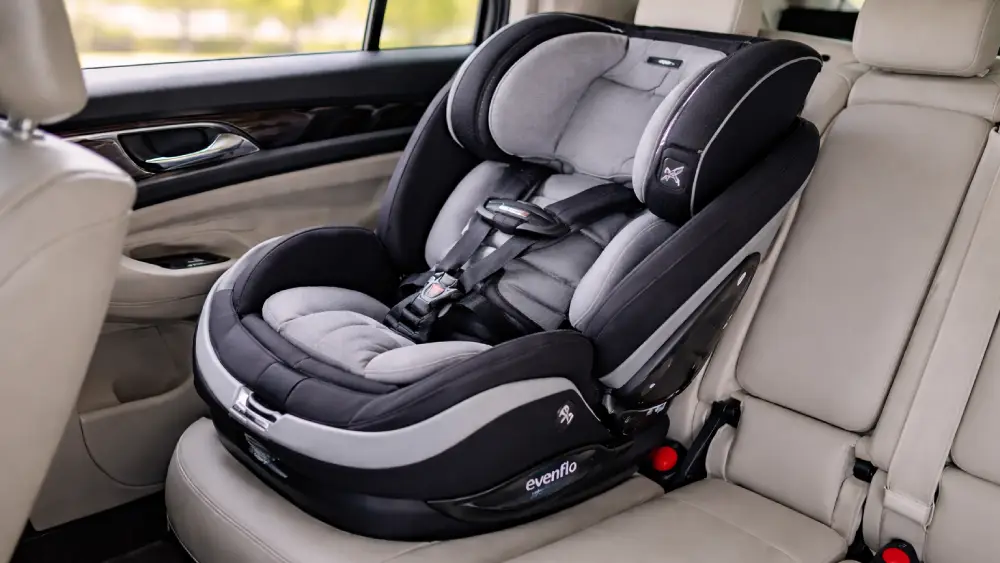
The Evenflo 360 car seat rear facing weight limit is one of the most important numbers you’ll look at as a parent — and one of the most misunderstood. It determines how long your child can stay in the safest riding position possible. And that matters more than most people realize.
Rear-facing isn’t just a recommendation. It’s a protection strategy. The Evenflo Revolve360 lineup has made extended rear-facing more convenient than ever with its rotating design, but convenience doesn’t replace understanding the limits. In this guide, I’ll break down the exact rear-facing weight limits, explain how they differ by model, and show you how to maximize safety without guessing.
Let’s get into it.
What Is the Rear-Facing Weight Limit for the Evenflo 360?
Most Evenflo Revolve360 models allow rear-facing use from 4 pounds up to 40 pounds.
However, the Revolve360 Extend model increases the rear-facing weight limit to 50 pounds, which is significant for families who want to rear-face well beyond age two.
Here’s a quick breakdown:
| Model | Rear-Facing Weight Limit | Rear-Facing Height Limit |
| Evenflo Revolve360 | 4–40 lbs | Up to 40 inches* |
| Revolve360 Slim | 4–40 lbs | Up to 40 inches* |
| Evenflo Gold Revolve360 | 4–40 lbs | Up to 40 inches* |
| Revolve360 Extend | 4–50 lbs | Up to 48 inches* |
*Always confirm exact limits on your specific seat label and manual.
This is where parents often miss a critical detail: you must follow both the weight AND height requirements. Whichever limit your child reaches first determines when rear-facing must stop.
The Evenflo 360 car seat rear facing weight limit is not flexible. It’s engineered into the crash testing standard for that model.
Why Rear-Facing Weight Limits Matter So Much
In a frontal crash — the most common and most severe type — a rear-facing seat supports the head, neck, and spine as a unit. A forward-facing child absorbs that force differently. The stress transfers to the neck. That’s a problem for toddlers whose spinal bones are still developing.
Rear-facing spreads the force across the entire back of the seat.
It’s physics. Not preference.
The American Academy of Pediatrics recommends children remain rear-facing until they reach the maximum height or weight allowed by their car seat. Not until age two. Not until their legs look cramped. Until they outgrow the limits.
That’s why understanding the Evenflo 360 car seat rear facing weight limit is more than checking a box. It’s deciding how long your child gets optimal crash protection.
And here’s something many parents don’t realize: most children outgrow seats by height before weight. Which means tracking both measurements regularly is essential.
Revolve360 Extend vs Standard Model: Which One Buys You More Time?
If your goal is extended rear-facing — and for many safety-conscious parents it is — the Revolve360 Extend deserves attention.
The standard Revolve360 caps rear-facing at 40 pounds. The Extend version raises that to 50 pounds.
That extra 10 pounds can translate into an additional year or more of rear-facing use for some children.
Let’s compare the impact:
- A 3-year-old weighing 38 pounds can continue rear-facing in either model.
- A 4-year-old weighing 44 pounds must switch forward-facing in the standard model.
- That same 4-year-old can remain rear-facing in the Extend.
That difference matters.
Of course, the Extend model typically costs more. But when you divide that cost over four to five years of use, the per-year difference is minimal. For families with taller or solidly built toddlers, the Extend model provides real longevity.
If you’re shopping specifically for a higher Evenflo 360 car seat rear facing weight limit, the Extend is the clear winner.
Weight Limit vs Height Limit — Which Comes First?
This is where confusion creeps in.
A child must stay within:
- The rear-facing weight range
- The rear-facing height range
- The headrest positioning rule (usually at least 1 inch of shell above the head)
If your child weighs 35 pounds but exceeds the height limit, rear-facing must stop. If your child is under the height limit but exceeds the weight limit, same outcome.
There’s no “close enough.”
Practical steps you can take:
- Weigh your child every 3 months once they pass age 2.
- Measure standing height twice a year.
- Check harness slot positioning regularly.
- Review your manual for headrest rules — this is often overlooked.
I’ve seen parents assume they’re safe because their child “looks small.” That’s not how car seats work. Numbers matter.
When Should You Switch to Forward-Facing?
Short answer: only after your child reaches the rear-facing maximum.
Longer answer: as late as your seat allows.
Common myths that push parents to switch early:
- “Their legs look cramped.” (Leg injuries are rare in rear-facing crashes.)
- “They’re almost three.” (Age alone isn’t a safety metric.)
- “They’re uncomfortable.” (Most kids adapt easily.)
The Evenflo 360 car seat rear facing weight limit exists because that’s what the seat has been tested to withstand in a crash. Switching before that point reduces the protection available.
If your child is approaching 40 pounds in a standard Revolve360 and you want more time rear-facing, upgrading to the Extend model may be worth considering.
How to Check Your Exact Rear-Facing Limits
Never rely solely on online summaries.
Instead:
- Check the white label on the side or back of your seat.
- Locate the manual — physical copy or downloadable from Evenflo’s website.
- Confirm the exact model name (Revolve360, Slim, Extend, Gold).
- Look specifically under the “Rear-Facing Mode” section.
Manufacturers occasionally update limits in newer production runs. The label on your physical seat is the final authority.
If you’re buying secondhand — which many safety experts discourage — this becomes even more critical. Limits and safety standards change.
Installation Tips for Rear-Facing Evenflo 360 Seats
The rotating feature makes daily use easier. But installation must still be precise.
Here’s what to focus on:
- Ensure the recline indicator shows the correct angle for your child’s age and size.
- Use either LATCH or seat belt — not both unless the manual allows.
- Check for less than 1 inch of movement side-to-side at the belt path.
- Confirm the anti-rebound feature (if equipped) is properly installed.
- After installation, rotate the seat to verify smooth movement without loosening.
A poorly installed seat compromises safety, regardless of the Evenflo 360 car seat rear facing weight limit.
If you’re unsure, schedule a check with a certified Child Passenger Safety Technician (CPST). Many fire stations and hospitals offer this service free.Safety Certifications and Structural Design
All Evenflo Revolve360 seats meet Federal Motor Vehicle Safety Standard 213 (FMVSS 213).
Key safety features often include:
- Reinforced steel frame elements
- Energy-absorbing foam
- Side impact testing protocols
- 5-point harness systems
But certification alone isn’t the full story. How long you use rear-facing mode makes a measurable difference in crash outcomes.
And that brings us back — again — to the Evenflo 360 car seat rear facing weight limit.
Final Thoughts: Maximizing Rear-Facing Safety
Here’s the bottom line.
The standard Evenflo Revolve360 allows rear-facing from 4 to 40 pounds. The Revolve360 Extend increases that to 50 pounds. Height limits and headrest positioning rules also apply.
If you want to maximize safety:
- Rear-face as long as your seat allows.
- Track both weight and height.
- Install carefully.
- Recheck limits every few months after age two.
Convenience is great. The rotating feature is genuinely helpful — especially for parents dealing with tight parking spaces or back strain. But the real value of the Evenflo 360 lineup lies in how long it allows you to maintain the safest riding position.
The Evenflo 360 car seat rear facing weight limit isn’t just a specification buried in a manual. It’s a timeline. One that directly influences your child’s safety every time you drive.
And when it comes to car seats, clarity beats guesswork every single time.
If you’re choosing between models, think long term. Think growth patterns. Think safety margins.
Then choose the version that gives your child the most protected miles possible.
Frequently Asked Questions
Most models allow rear-facing from 4–40 pounds, while the Revolve360 Extend allows up to 50 pounds.
Your child can remain rear-facing until they reach the maximum weight or height limit listed on your specific model.
Yes, the Extend version allows rear-facing up to 50 pounds, while most other versions cap at 40 pounds.
Rear-facing must stop once either the height or weight limit is exceeded, whichever comes first.
Yes, if your child is still within the seat’s rear-facing height and weight limits.
No, the rotating mechanism does not change the Evenflo 360 car seat rear facing weight limit.
Check the label on the side of the seat and review the user manual for model-specific limits.
For many children it is, but the Extend model provides extra capacity up to 50 pounds for longer use.
While legally allowed in many areas, safety experts recommend staying rear-facing until the maximum limit.
No, children can safely sit with bent legs; leg discomfort is not a safety concern in rear-facing mode.